Baby & Kids Patterns · Easy
Beginner Crochet Baby Blanket in Soft Stripes
A striped baby blanket is just one stitch, repeated until it feels like a gift. The long middle is just one stitch, repeated patiently.
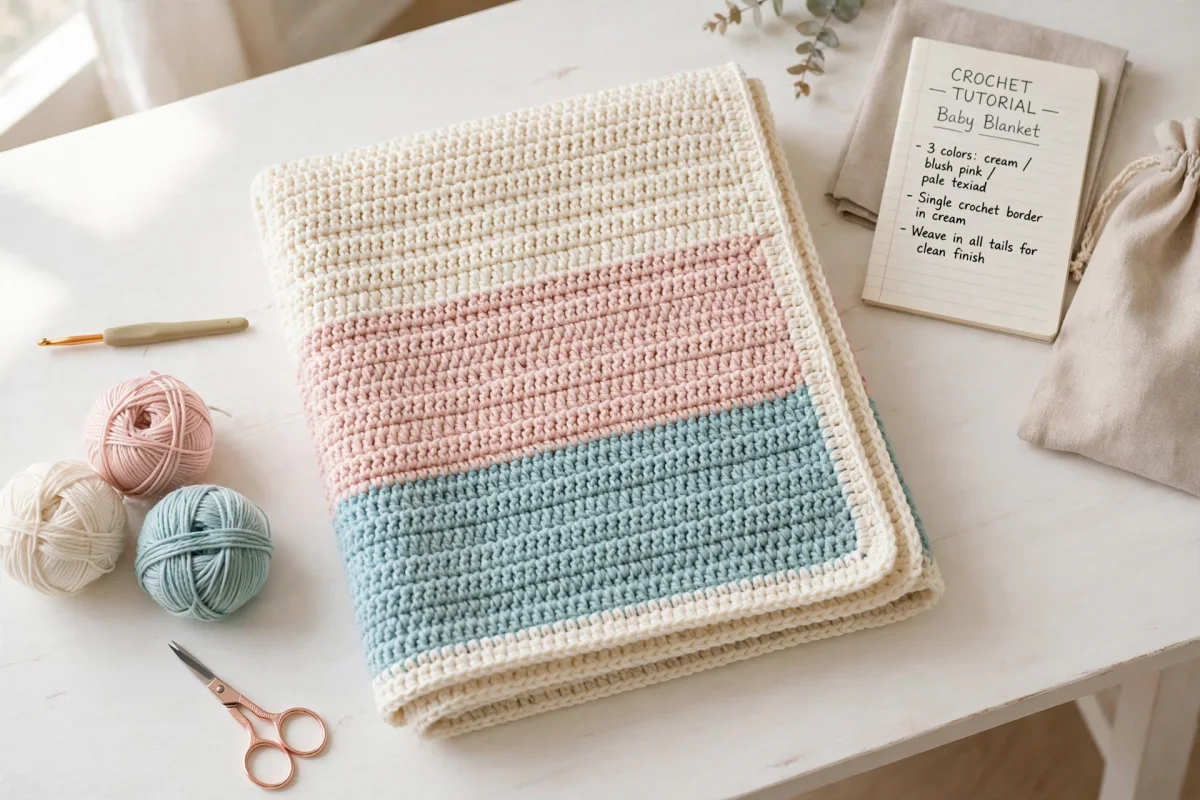
A striped baby blanket is just one stitch, repeated until it feels like a gift. This tutorial keeps you company through the long middle: every step spelled out, real numbers for sizing, and pictures of the stages where beginners usually stall.
A first blanket doesn't need to be clever. It should be soft, washable, and finished. Stripes give you little celebrations so the middle of the project does not swallow you. We will work the whole blanket in half double crochet, which grows faster than single crochet but still looks neat and even. One stitch, three colors, and a quiet rhythm — that is the entire pattern.
Before you begin
Gather everything before the first chain. Blankets punish mid-project shopping trips.
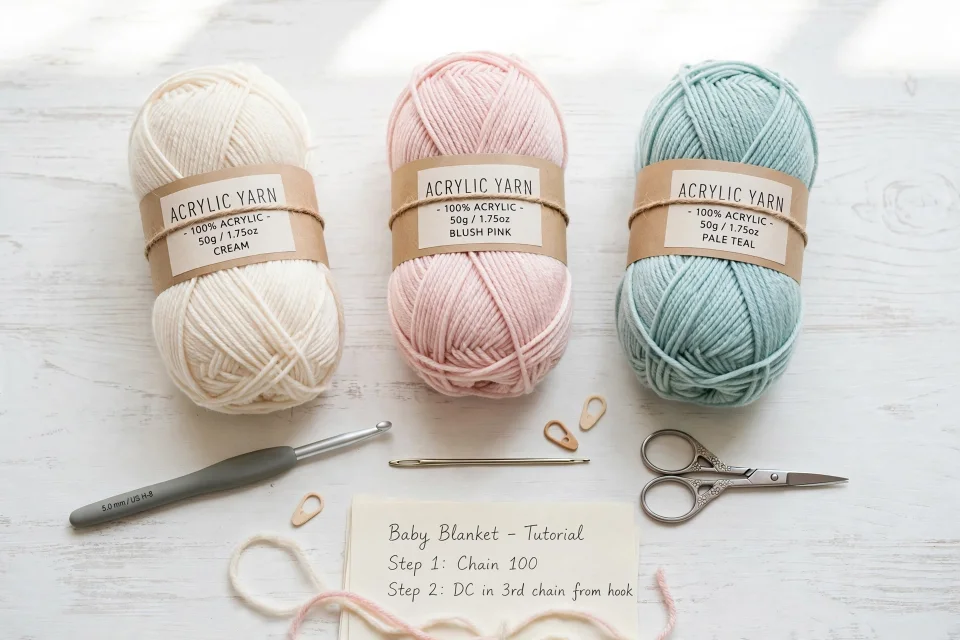
What materials do you need?
- Yarn: soft acrylic baby yarn, DK or light worsted weight. 3 skeins of cream (main color), 1 skein of blush pink, 1 skein of pale teal. Each skein should be about 100 g / 300 m — that gives you roughly 1500 m total, enough for a generous crib throw with yarn to spare for the border.
- Hook: 5.0 mm (H-8). If you crochet tightly, try 5.5 mm; if loosely, 4.5 mm.
- Notions: yarn needle with a large eye, small sharp scissors, a row counter or a pencil and paper, and two stitch markers or safety pins.
Gauge
With a 5.0 mm hook, most crocheters get about 14 half double crochet stitches and 11 rows per 10 cm in this yarn. Your hands are not most crocheters, so swatch: chain 20, work 10 rows of half double crochet, measure the middle 10 cm. If you have more than 14 stitches, go up a hook size; fewer, go down. A blanket that is 5 cm narrower than planned is a disappointment you can prevent in twenty minutes.
Finished sizes
- Crib throw (this pattern): about 75 cm wide × 90 cm long.
- Smaller stroller blanket: about 60 × 75 cm — chain fewer stitches (see the math below) and stop the stripe repeat earlier.
- Larger toddler blanket: about 90 × 110 cm — buy one extra skein of cream.
Stitch abbreviations (US terms)
- ch — chain
- hdc — half double crochet
- sc — single crochet
- sl st — slip stitch
- st(s) — stitch(es)
- rep — repeat
If half double crochet is new to you: yarn over, insert the hook into the stitch, yarn over and pull up a loop (three loops on the hook), yarn over and pull through all three loops. One smooth motion once your hands learn it.
The steps, slowly
Step 1 — Chain your foundation
With cream, make a slip knot and chain loosely. For the 75 cm crib throw, chain 110 (check against your swatch: you want the chain to measure about 75 cm without stretching it). Loose matters more than exact — a tight foundation chain is the number one reason blanket edges pull in. If your chains are always tight, chain with a 5.5 mm hook, then switch to 5.0 mm for row 1.
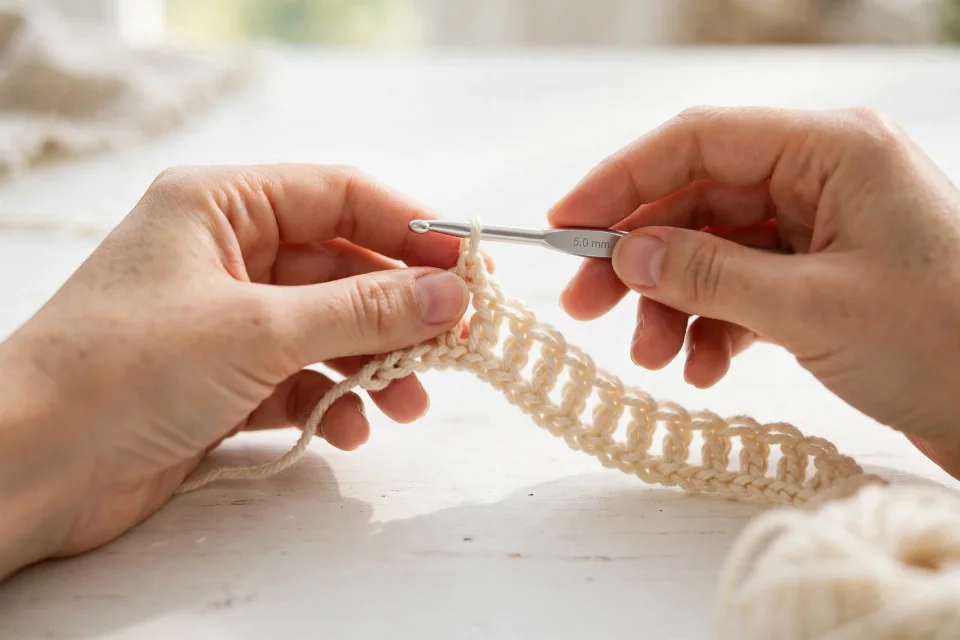
Count your chains twice. Mark every 20th chain with a stitch marker as you go so you do not have to recount from the beginning when you lose track at 87.
Step 2 — Row 1
Yarn over, insert your hook into the third chain from the hook (the two skipped chains count as your first half double crochet), and work 1 hdc in each chain across. You should have 109 stitches: 108 hdc plus the two skipped chains, which count as the first stitch. Count once now; the same 109 should come back on every row.
Step 3 — Build the cream section
Chain 2 (counts as first hdc), turn. Skip the first stitch (the turning chain already stands in for it), work 1 hdc in each stitch across, and work the last hdc into the top of the turning chain from the row below. (109 sts) Work under both top loops and keep your tension even. Repeat until you have 8 rows of cream total, including row 1.
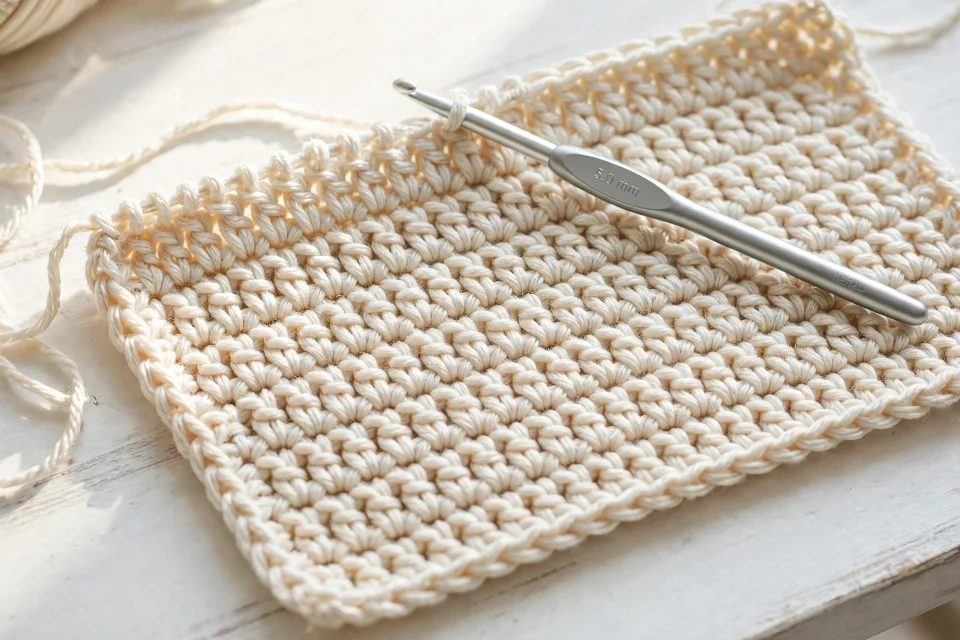
After row 3, lay the work flat and check the width against your target. Now is the moment to adjust — frogging 3 rows is a sigh; frogging 30 is a tragedy.
Step 4 — Change color the clean way
Work the last stitch of your final cream row until the last yarn-over: yarn over, insert, pull up a loop, and then — instead of finishing with cream — lay the blush yarn across the hook and pull it through all three loops. Snip the cream, leaving a 15 cm tail. The new color now sits on your hook, ready for the turning chain, and the color change lands exactly on the edge with no blip.
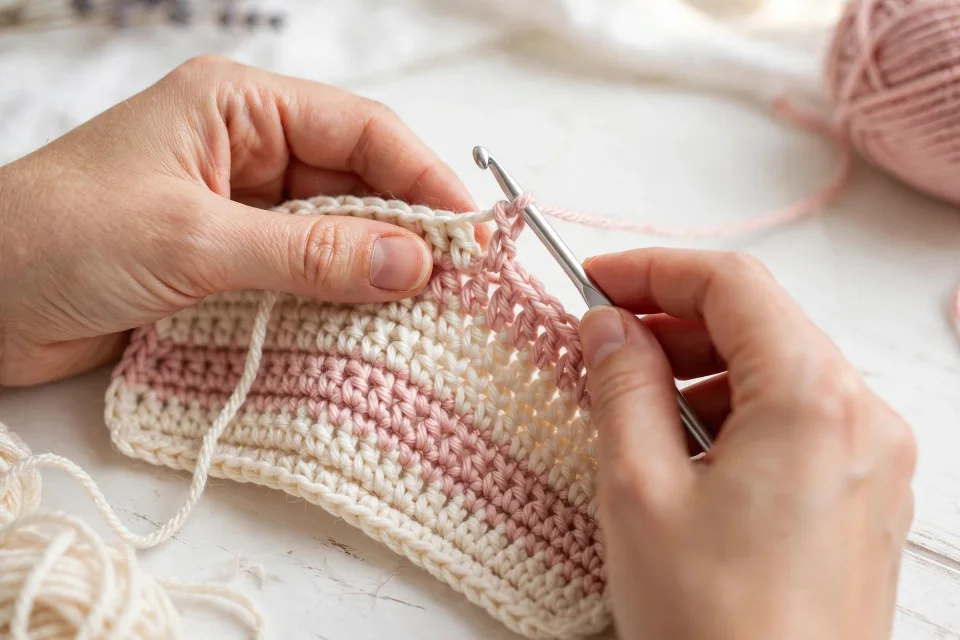
Do not weave ends yet if stopping breaks your rhythm. Leave 15 cm tails hanging and promise yourself a podcast later. (Keep the promise. Tails left for months become a nest.)
Step 5 — Work the stripe sequence
The stripe story for this blanket is:
- 8 rows cream
- 2 rows blush pink
- 4 rows cream
- 2 rows pale teal
- 8 rows cream
That 24-row block is one full repeat. Work it four times for the 90 cm length, ending with a cream block. Keep a row counter, or tallies on paper — blankets lie about how many rows you have done, and "about 90 cm" measured with a tape is the only truth that counts.
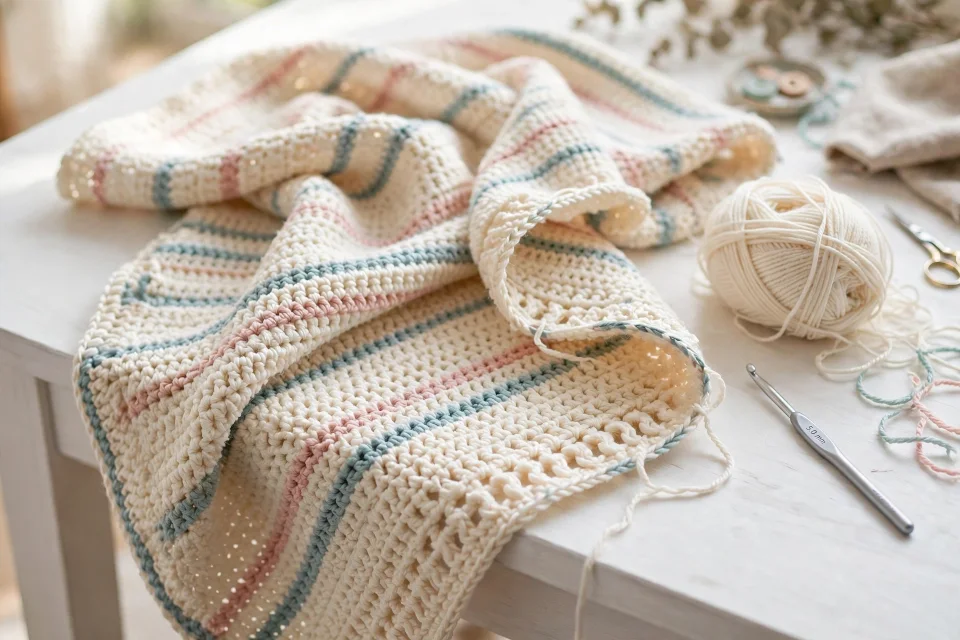
A note on carrying yarn: because every stripe is an even number of rows, each color change happens at the same edge. Carry the cream loosely up that side during the 2-row pink and teal stripes instead of cutting it; the border will cover the strands later. Pink and teal are cut after their stripe, because they don't come back for many rows.
Step 6 — Add the border
With cream, join with a slip stitch in any corner. Chain 1, then work single crochet evenly around all four sides, putting 3 sc in each corner stitch so the corners turn flat instead of curling. Along the row-ends (the sides), work about 2 sc per row — if the edge ripples, you have too many; if it pulls in, too few. Work 2 rounds total, joining each round with a slip stitch to the first sc.
Step 7 — Finish like you mean it
Fasten off with a 15 cm tail. Thread your yarn needle and weave every tail through the backs of stitches, changing direction once — a tail woven in a zigzag survives the wash; a straight one wiggles free. This is the unglamorous part and the part that makes it a real blanket instead of a project. Put on the podcast.
Care notes
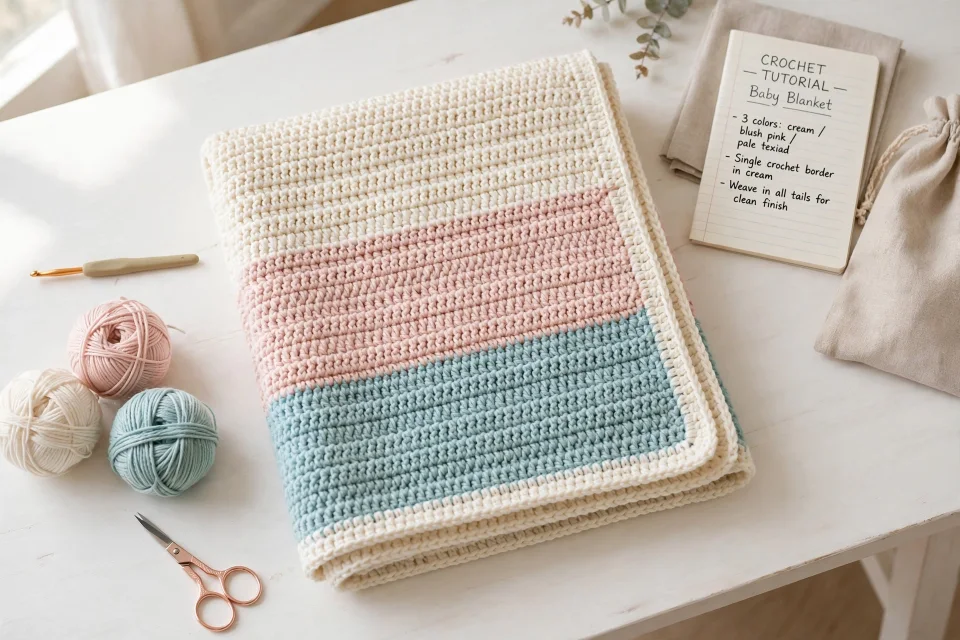
Wash the blanket before you wrap it — softness is part of the gift, and the first wash settles the stitches. Machine wash gentle in cool water, tumble dry low or lay flat. Write a little note about the yarn (brand, fiber, washing instructions) and tuck it in with the gift, so someone can wash it kindly for years.
What are the common mistakes, and how do you fix them?
- Forgetting to skip the first stitch. When the chain 2 counts as a stitch, working into the first stitch adds one stitch every row. Count to 109 every few rows.
- Missing the turning chain at the end. The last hdc goes into the top of the previous row's chain 2. Skip it and the blanket loses a stitch every row and the edge slants.
- A tight foundation chain. If the bottom edge is narrower than the rest, the chain was too tight. Chain with a hook one size larger next time; for this blanket, the border will ease small differences.
If this happens
Wavy edges: usually your tension changes when you change color. The last-yarn-over trick from Step 4 flattens more drama than any blocking. Also check you are not accidentally adding stitches at the row ends — count your stitches every few rows.
The blanket is growing wider (or narrower): you are adding or dropping the last stitch of the row. Put a stitch marker in the first and last stitch of every row until your hands stop wandering.
Stripes look jogged at the join: normal for rows worked flat — the step is one stitch tall and nearly invisible after washing. Do not chase perfection here.
Running out of cream early: the two border rounds need about 50 m (55 yd) of cream. If cream is getting thin, finish the body one repeat shorter and keep enough for two full border rounds.
Frequently asked questions
Can I make this in one color?
Absolutely — it becomes a beautifully textured solid blanket. The stripe instructions simply become "keep going until it is 90 cm long." The border still earns its place.
How long does it take?
Most beginners finish in two to three weeks of evening stitching — roughly 12 to 15 hours total. Half double crochet is the sweet spot: noticeably faster than single crochet, much tidier than double for a first blanket.
Is acrylic yarn okay for a baby?
Yes — soft baby acrylic is the practical choice: hypoallergenic, machine washable, and it survives being loved hard. Choose yarn labeled "baby" or "soft" and avoid anything scratchy or with a halo that sheds.
Can I use double crochet instead?
You can. The blanket will grow faster and drape more loosely, but the fabric will be airier. Keep the same stitch counts; just know your stripe rows will measure taller, so check length with a tape rather than counting rows.
A last note from the sofa
The middle of a blanket is a long, quiet country. That is not a flaw in the pattern; it is the pattern. Some evenings you will make ten rows and feel rich. Some evenings you will make two and feel honest. Both count. When it is done, wash it, fold it, and notice that your hands made a thing a baby will actually use. That never gets old.
Comments
No comments yet. Questions, corrections, and notes from your own attempt are welcome.