How to Crochet the Moss Stitch (Easy Moss Stitch Scarf)
Learn the crochet moss stitch (also called linen or granite stitch) step by step with straight edges and exact stitch counts, then use it for an easy worsted-weight scarf that makes a great handmade gift. US terms, with troubleshooting and FAQ.
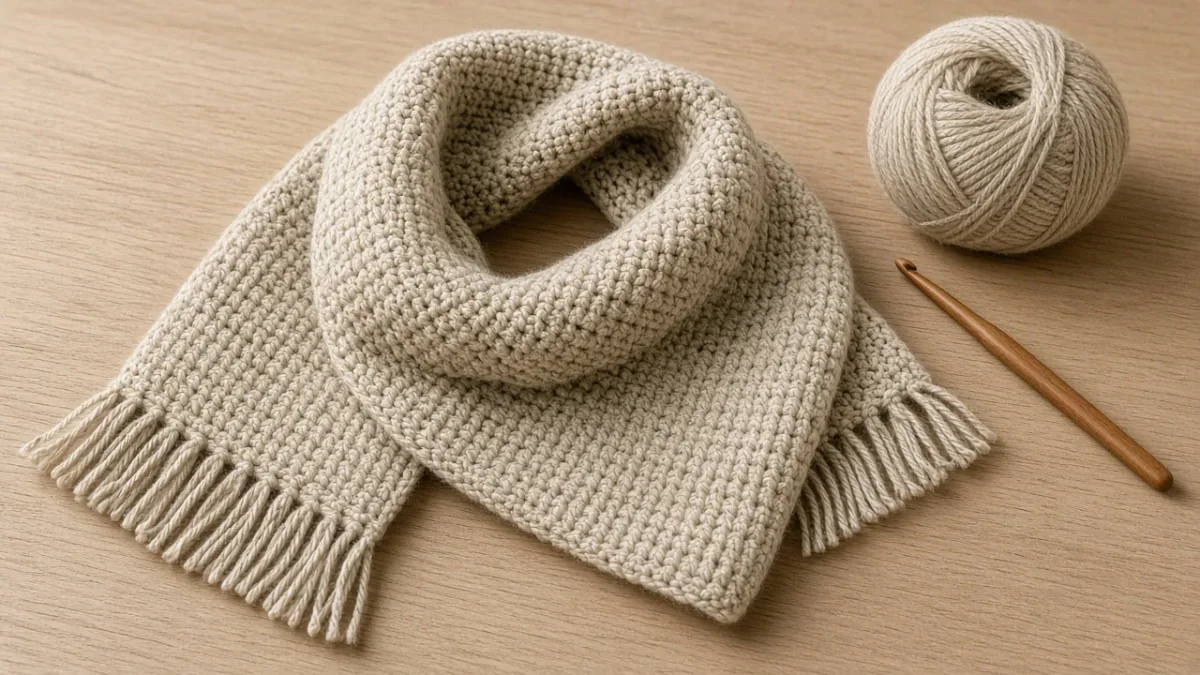
The moss stitch is one of the most useful textures a beginner can learn. It uses nothing but chains and single crochet, yet the finished fabric looks woven, lies flat, and has a gentle drape that plain single crochet rows rarely have. You will also see it called the linen stitch or granite stitch; all three names describe the same alternating pattern of single crochet and chain-1 spaces.
This tutorial explains how the stitch works, gives a small practice swatch, and then turns it into an easy moss stitch scarf. A scarf is a good first project for this stitch because it is just a long rectangle, so all of your attention can go to the rhythm of the pattern. It also makes a practical handmade gift for the holidays.
Before You Begin
Skills needed: slip knot, chain, and single crochet. If your foundation chain tends to twist, read how to fix a twisted chain before you start, because the first row of moss stitch is worked into every other chain.
Abbreviations (US terms): ch = chain, sc = single crochet, sk = skip, sp = space, st(s) = stitch(es). A "ch-1 sp" is the small gap under a single chain from the previous row. Numbers in brackets give the count at the end of a row.
What Materials Do You Need?
- Worsted weight (#4) yarn, about 350 to 450 yd (320 to 410 m) for an adult scarf about 6.5 in by 60 in
- 5.5 mm (US I-9) crochet hook
- Yarn needle and scissors
- Two stitch markers (optional, but helpful for the edge stitches)
Choose a smooth, light-colored yarn for your first try. Fuzzy or very dark yarn hides the chain spaces and makes it harder to see where the next stitch goes. Wool and wool blends give a warm, springy scarf; acrylic is easy to wash and budget-friendly. To plan yardage for a different size, the project yardage calculator helps you estimate how many skeins to buy.
Gauge: about 16 sts and 16 to 18 rows = 4 in (10 cm) in moss stitch, counting every sc and every ch-1 as one stitch. Gauge is not critical for a scarf, but it controls the width and the amount of yarn you use, so make the swatch below and measure it after a light steam or soak.
How the Moss Stitch Works
Every row alternates one sc with one ch-1. On the next row, you skip each sc and work a new sc into the ch-1 space below it. That simple swap is what staggers the stitches like bricks and gives the fabric its woven look. The result is drapier than solid single crochet but still dense enough to keep wind out.
The only part that needs care is the edges. In the pattern below, the rows alternate between two versions so that both side edges stay straight: one version starts and ends with a single sc, the other starts and ends with two sc side by side.
Practice Swatch
Ch 18 (any even number works). Work Row 1 as written below: you will have 9 sc and 8 ch-1 sps (17 sts). Then repeat Rows 2 and 3 about 10 times. Row 2 versions will have 10 sc and 7 ch-1 sps (still 17 sts). Measure the center of the swatch to check your gauge, and look for the brick-like pattern on both sides.
Easy Moss Stitch Scarf Pattern
Finished size: about 6.5 in (16.5 cm) wide by 60 in (152 cm) long before the optional border and fringe.
Foundation
Ch 28. Keep the chain loose and even; if your chains are tight, make them with a hook one size larger and switch back for Row 1.
Row 1
Sc in 2nd ch from hook, *ch 1, sk next ch, sc in next ch; repeat from * across. Turn. [14 sc, 13 ch-1 sps = 27 sts]
Check: after the first sc you have 26 chains left, which make 13 pairs of "skip one, sc in the next", so the row ends with a sc in the very last chain.
Row 2
Ch 1 (does not count as a stitch). Sc in first sc, sc in next ch-1 sp, *ch 1, sk next sc, sc in next ch-1 sp; repeat from * across until you have worked into every ch-1 sp, then sc in the last sc. Turn. [15 sc, 12 ch-1 sps = 27 sts]
Both ends of this row have two sc next to each other. That is correct and is what keeps the edges straight.
Row 3
Ch 1 (does not count as a stitch). Sc in first sc, *ch 1, sk next sc, sc in next ch-1 sp; repeat from * across until you have worked into every ch-1 sp, then ch 1, sk next sc, sc in last sc. Turn. [14 sc, 13 ch-1 sps = 27 sts]
This row matches Row 1: a single sc at each end, with a chain space next to it.
Rows 4 and up
Repeat Rows 2 and 3 until the scarf measures about 60 in (152 cm), or your chosen length, ending with a Row 3 so both short ends look the same. At the gauge above, that is roughly 240 to 270 rows. Fasten off, leaving a 6 in tail.
If you lose your place, count the sts in the last row: 15 sc means you just finished a Row 2, and 14 sc means you just finished a Row 1 or Row 3. Our guide to counting crochet stitches and rows explains how to read the fabric if you are unsure.
Finishing
- Optional border: join yarn at a corner, ch 1, and work sc evenly around the scarf, with 3 sc in each corner. On the short ends, work 1 sc in each st and each ch-1 sp. On the long sides, work about 1 sc in each row end. Join with a sl st to the first sc and fasten off. The simple scarf with a clean border shows the same corner method in more detail.
- Weave in ends along the edge sts rather than across the open texture, where they can show through. See how to weave in ends so they never pop out.
- Block: lay the scarf flat, gently straighten the edges, and mist or steam it (follow the yarn label). Moss stitch relaxes noticeably after blocking. Our guide to blocking crochet pieces covers both wet and steam methods.
- Optional fringe: cut 10 in (25 cm) strands, fold two together, and knot them through every other st along each short end. Trim evenly.
Sizes and Variations
- Change the width: the foundation chain must always be an even number. Add or remove chains in pairs: each extra 2 ch adds 2 sts, or about half an inch at this gauge.
- Child scarf: ch 22 for about 5 in wide and work to about 45 in long. For other sizes, the scarf size calculator suggests widths and lengths by age.
- Stripes: moss stitch looks great in stripes of two or three rows. Change colors on the last yarn-over of the final sc in a row so the new color starts clean.
- Cowl: work to about 24 to 26 in long and sew the short ends together for a quick loop that slips over the head.
Troubleshooting
The scarf is getting wider or narrower. Count your sts every few rows. Narrowing usually means the last sc of a row was skipped; widening usually means an extra sc slipped in at the edge. Both edges should alternate between "single sc" and "two sc side by side" from row to row.
The texture looks like columns instead of bricks. You are working into the sc of the previous row instead of the ch-1 spaces. Every new sc goes into a chain space, and every chain sits above a sc.
The fabric is stiff. Try a hook one size larger, or check whether your chains are much looser or tighter than your sc. If your tension changes from day to day, our guide on keeping even tension in crochet has simple fixes.
I can't find the chain spaces. Work in good light and use a lighter yarn. The chain space is the small hole directly under a single chain, between two sc.
Frequently Asked Questions
Is the moss stitch the same as the linen stitch?
Yes. In crochet, moss stitch, linen stitch, and granite stitch are common names for the same sc and ch-1 pattern. Some knitting patterns use "moss stitch" for a different knit-purl texture, so check which craft a pattern is written for.
Is moss stitch good for beginners?
Yes. If you can chain and work single crochet, you can work moss stitch. The new skill is placing stitches into chain spaces, which most people pick up within a few rows.
Why does the foundation chain need an even number?
The first sc uses one chain, and every repeat after it uses two chains. An even total leaves an even number of chains after the first sc, so the row ends neatly with a sc in the last chain.
Does moss stitch use more yarn than single crochet?
It generally uses a little less for the same area, because the chain spaces are lighter than full stitches. Yarn use still depends on your tension and yarn, so buy an extra skein if you are near the estimate.
#moss stitch #linen stitch #crochet scarf #easy crochet scarf #crochet stitches #beginner crochet #crochet gifts #winter crochet
Comments
No comments yet. Questions, corrections, and notes from your own attempt are welcome.