Beginner Basics Stitches · Easy
US vs UK Crochet Terms: The Complete Conversion Guide
US double crochet is UK treble - one small naming shift that has ruined many a blanket. This guide converts every stitch, explains the turning-chain trap, and walks you through a four-stripe sampler so you can read either system with confidence.
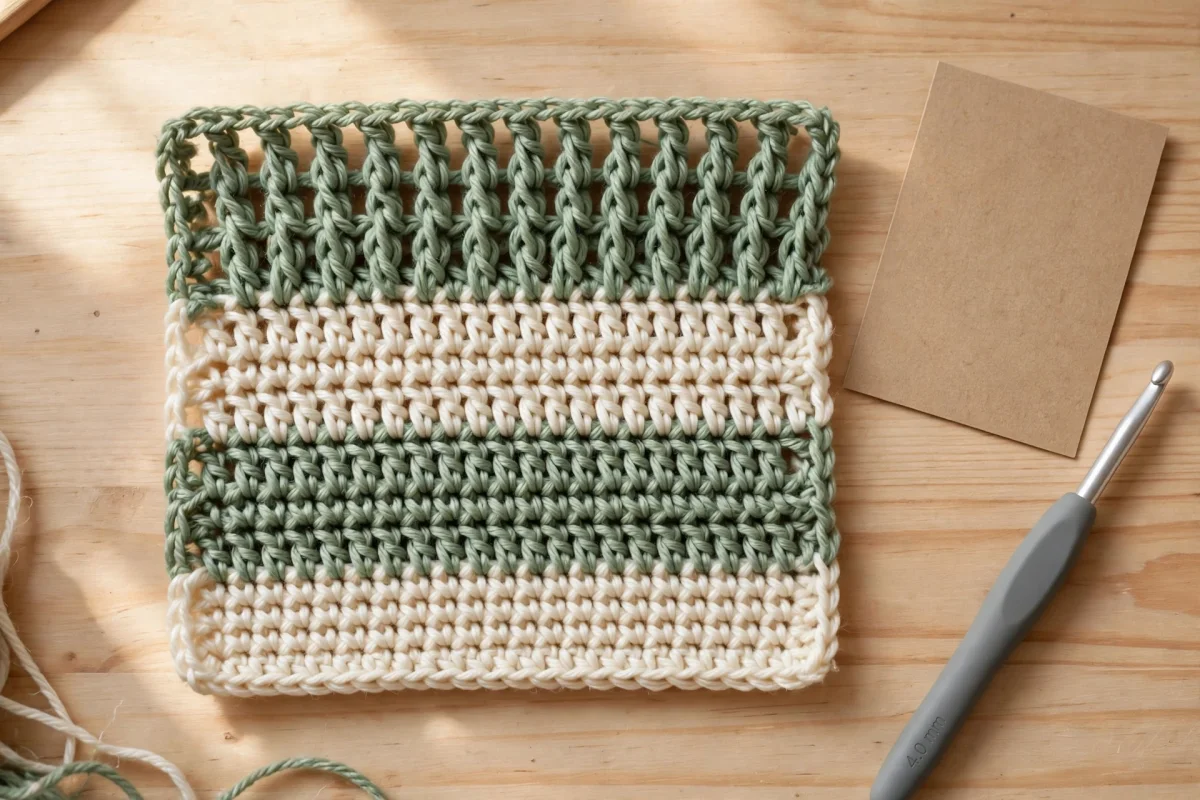
Picture this: you find a beautiful blanket pattern, you follow it stitch for stitch, and three rows in, your blanket is twice as tall as the photo and full of holes you did not ask for. You did nothing wrong. The pattern was written in UK terms, and you were reading it in US terms — or the other way around. The two systems use the same names for different stitches, shifted by exactly one step, and that one step is the most common trap in all of crochet.
This guide clears it up once and for all. You will learn the full conversion chart, why the shift exists, how to tell which system any pattern uses before you cast on a single stitch, and — best of all — you will crochet a small four-stripe sampler with us, stitch by stitch, so your hands learn the difference your eyes keep missing. Keep the finished sampler beside your patterns and you will never translate a stitch wrong again.
Materials
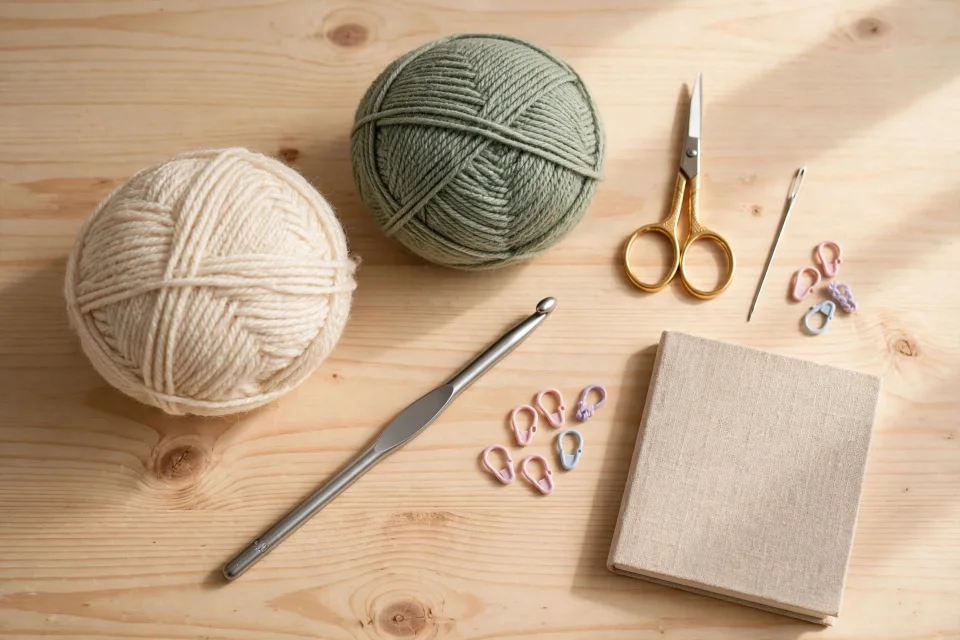
- Worsted (#4) yarn in cream, about 30 g — stripes 1 and 3
- Worsted (#4) yarn in sage green, about 30 g — stripes 2 and 4
- 4.0 mm (G-6) crochet hook
- Yarn needle, scissors and 2 stitch markers
- Pins and a towel for blocking the finished sampler
- A small notebook or card to write out your own conversion chart
Gauge and size: about 16 stitches x 18 rows of single crochet = 4 in (10 cm) in worsted yarn with a 4.0 mm hook. Gauge is not critical here — the sampler is a learning tool, not a garment — but do keep your tension even, because comparing stitch heights is the whole point. Finished sampler: about 7 in (18 cm) wide x 5.5 in (14 cm) tall.
About the terms in this guide: the instructions below are written in US terms, and every US stitch is paired with its UK name the first time it appears, so you can follow along whichever system you already know. The conversion table is the heart of this tutorial — bookmark this page for it alone.
The conversion chart: the same names, shifted one step
Here is the whole secret in one table. US and UK crochet agree on slip stitch and chain, and then the UK names run exactly one step higher than the US names for the same stitch. A US single crochet and a UK double crochet are the very same stitch, worked the very same way — only the name differs.
| US term | US abbreviation | UK term | UK abbreviation |
|---|---|---|---|
| Slip stitch | sl st | Slip stitch | ss |
| Single crochet | sc | Double crochet | dc |
| Half double crochet | hdc | Half treble | htr |
| Double crochet | dc | Treble | tr |
| Treble crochet | tr | Double treble | dtr |
| Double treble crochet | dtr | Triple treble | trtr |
| Chain | ch | Chain | ch |
Why did this happen? The two traditions grew up separately. American crocheters named stitches by how the stitch is built — a single crochet is one plain stitch, a double crochet wraps the yarn once more, a treble wraps it again. British crocheters named them by counting the yarn-overs in a slightly different way, so their "double" describes what Americans call a "single". Neither system is wrong; they simply started counting from different places, and by the time the internet put both on the same screen, the names were already set in stone.
Two more differences hide in the wording of instructions. Americans write "yarn over" (yo); British patterns usually write "yarn round hook" (yrh) for the same movement. And when a pattern says "work in the round", both systems mean the same thing — the danger is only ever in the stitch names themselves.
Stage 1 — Stripe 1: US single crochet = UK double crochet
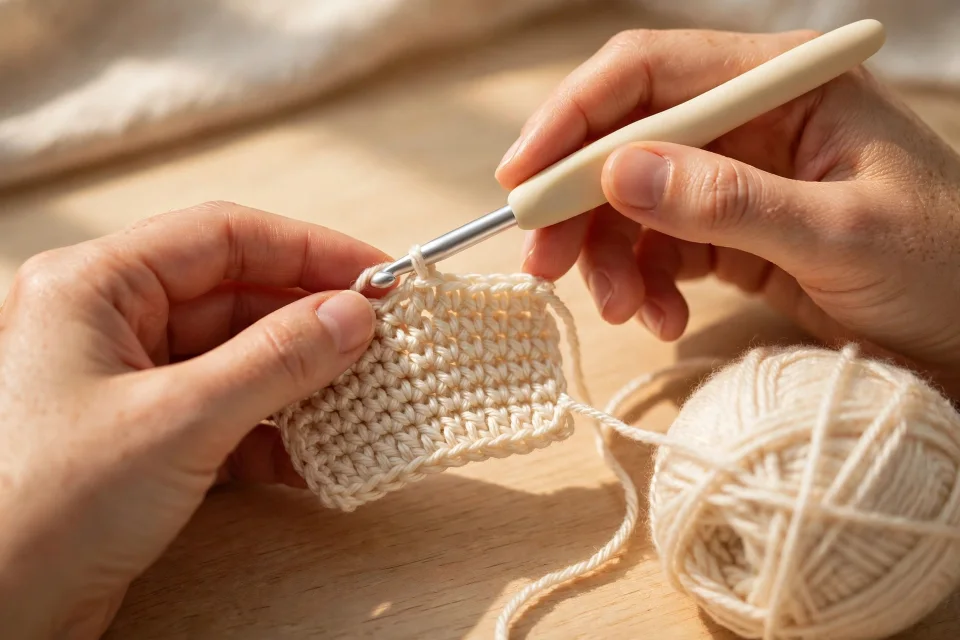
We start with the shortest stitch and the most dangerous pair of names. In US terms this stripe is single crochet; in UK terms the identical stitch is double crochet. If you have ever read "dc" in a British pattern and worked an American double crochet, you made a stitch twice as tall as the designer intended — and now you know why your project grew.
- With cream, ch 25. (24 foundation chains plus 1 turning chain)
- Row 1: sc in the 2nd ch from the hook and in each ch across. (24 sc) Mark the first stitch of the row with a stitch marker.
- Rows 2–4: ch 1, turn, sc in every st across. (24 sc, 3 rows)
Look at the stripe you have just made: short, dense, with almost no gaps between the stitches. That is the hallmark of this stitch in either language. On your card, write: US sc = UK dc. This one line will save more projects than any other line in crochet.
Stage 1 tip: count your stitches at the end of Row 2. The turning chain at the start of a single crochet row is only 1 chain high and does not count as a stitch, so the first stitch of the row goes into the very first stitch of the row below, not into the turning chain. Missing it is how a swatch quietly loses a stitch every row.
Stage 2 — Stripe 2: US half double crochet = UK half treble
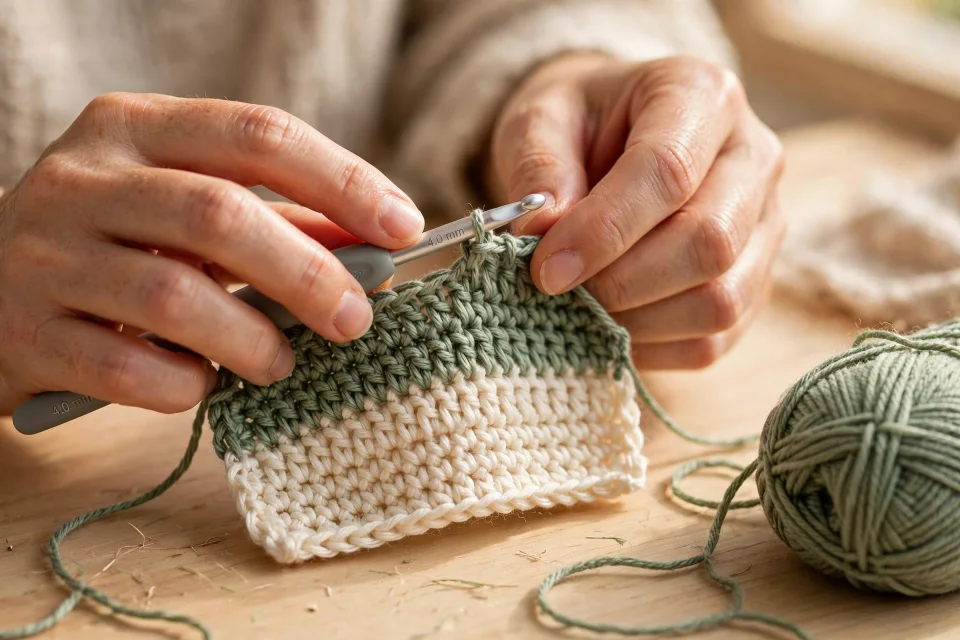
Change to sage green and work the next stripe one step taller. The half double crochet wraps the yarn once before entering the stitch, so it stands a little taller than single crochet and shows a neat horizontal bar across its front — that little bar is how you will recognise it forever after.
- Join sage green with a slip stitch in the first stitch of the last cream row, ch 2, turn.
- Row 1: hdc in every st across. (24 hdc) To work a half double crochet: yarn over, insert the hook, yarn over and pull up a loop (3 loops on the hook), yarn over and pull through all 3 loops.
- Rows 2–3: ch 2, turn, hdc in every st across. (24 hdc, 2 rows)
Compare the two stripes side by side. The sage stripe is a little taller and a little softer than the cream one below it, and each stitch carries that tell-tale bar. On your card, write: US hdc = UK htr. Notice that the turning chain here is 2 chains — turning chains match the height of the stitch that follows, and that rule is the same in both systems, which is why turning chains never need translating.
Common mistake: working into the turning chain at the end of a half double crochet row. The ch-2 turning chain is not a stitch, so your last half double goes into the last stitch of the row below, and you turn and chain 2 again. If your edge starts to slant, this is almost always the cause.
Stage 3 — Stripe 3: US double crochet = UK treble
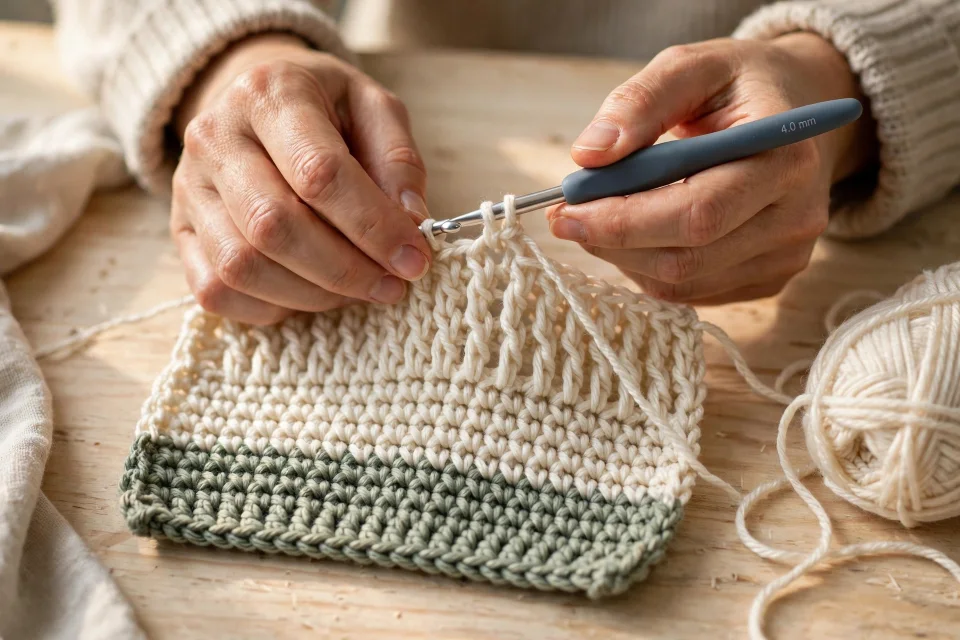
Back to cream for the stitch that causes the most confusion of all. An American double crochet wraps the yarn once, works through the loops in two steps, and stands about twice as tall as a single crochet. A British treble is the same stitch, worked the same way. Say it out loud while you work: "my double is their treble".
- Join cream with a slip stitch in the first stitch of the last sage row, ch 3, turn.
- Row 1: dc in every st across. (24 dc) To work a double crochet: yarn over, insert the hook, yarn over and pull up a loop (3 loops on the hook), yarn over and pull through 2 loops, yarn over and pull through the last 2 loops.
- Rows 2–3: ch 3, turn, dc in every st across. (24 dc, 2 rows)
Hold the sampler up and look at the three stripes together: short, medium, tall. You can already see the whole system in your hands. On your card, write: US dc = UK tr. This is the pair that ruins blankets, because a UK pattern that asks for treble all the way through becomes a completely different fabric if you read it as US treble — looser, taller, and twice as much yarn.
Stage 3 tip: the ch-3 turning chain at the start of a double crochet row usually counts as the first stitch in American patterns, so the first real double crochet of the row goes into the second stitch. British patterns treat their ch-3 the same way. If your count keeps coming out one stitch short, check whether you are skipping that second stitch or working into the turning chain by mistake.
Stage 4 — Stripe 4: US treble crochet = UK double treble
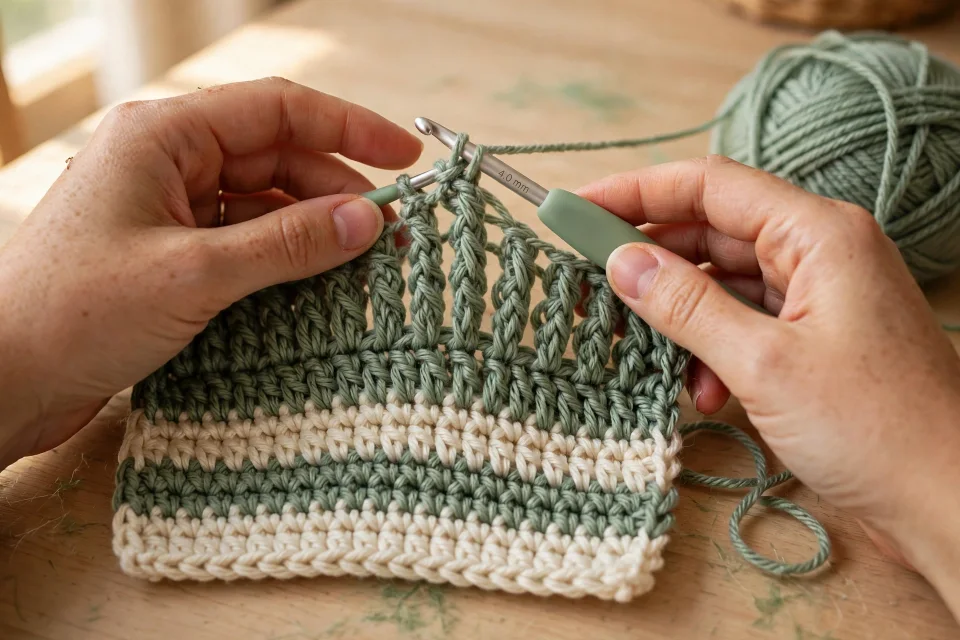
The tallest stripe in the sampler, and the last pair you need for almost every pattern you will ever meet. A treble crochet wraps the yarn twice before entering the stitch, so it stands tall and open, with a lovely drape that makes it the favourite stitch for lacy shawls and summer tops.
- Join sage green with a slip stitch in the first stitch of the last cream row, ch 4, turn.
- Row 1: tr in every st across. (24 tr) To work a treble crochet: yarn over twice, insert the hook, yarn over and pull up a loop (4 loops on the hook), then yarn over and pull through 2 loops, three times, until one loop remains.
- Rows 2–3: ch 4, turn, tr in every st across. (24 tr, 2 rows)
On your card, write: US tr = UK dtr. And for completeness, the next step up: a US double treble, with three yarn-overs, is a UK triple treble — you will meet it rarely, in very lacy work, and the same one-step rule covers it. Your sampler now shows four stripes of increasing height, exactly like the finished photo, and you have worked every stitch in the conversion chart with your own hands.
Common mistake: letting treble stitches lean. Tall stitches lean toward the working hand if your tension is uneven, so slow down on this stripe, keep each yarn-over the same size, and let the hook do the pulling. A leaning stripe is not a ruined stripe — blocking at the end will straighten it out.
Stage 5 — Finish, block and read your first UK pattern
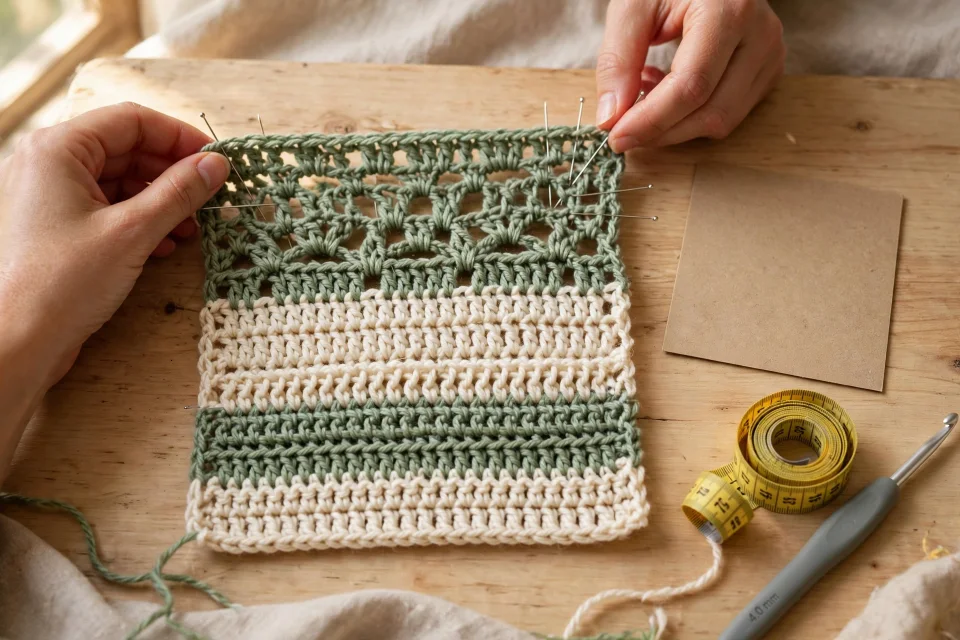
Fasten off, weave in the two colour-change ends with your yarn needle, and lay the sampler flat. Pin it to a towel, mist it lightly with water or steam it gently, and leave it to dry. Blocking is not just finishing — it is the moment your four stripes settle into four clean, measurable bands, and the height difference between them becomes obvious even to a stranger walking past.
- Measure each stripe and write its height on your card next to its two names.
- Write out the full conversion chart on the card, in your own handwriting, and keep the card with the sampler.
- Now try it: find any UK pattern — a simple scarf or a granny square — and read its first five rows, translating every stitch name with your chart before you pick up the hook. Translate the whole row, not just the stitch you are unsure about.
That last step matters more than the sampler itself. Most translation mistakes do not come from the chart — they come from translating only half a pattern: the stitches get converted, but the turning chains or the stitch counts are left in the other system. Read the row, translate the row, then crochet the row.
How to tell which system a pattern uses
Good patterns say so plainly — "US terms" or "UK terms" near the top, often right under the materials list. When a pattern does not say, play detective before you start:
- Where is the designer? A pattern from a US designer is almost always US terms; a British, Australian or South African designer usually writes UK terms. The designer's location is the single best clue.
- What does "double crochet" do? If the pattern's photos show short, dense stitches where it says "dc", it is UK terms. If the "dc" rows look tall and open, it is US terms.
- Check the abbreviations list. If you see "htr" or "tr" used for a medium-height stitch, you are in UK territory. If you see "hdc" anywhere, it is American — the UK system has no half double crochet.
- Look at the yarn and hook. UK patterns talk about DK, aran and 4-ply yarns and give hook sizes in millimetres; US patterns say worsted, bulky and fingering and often give a letter size like G-6 or H-8 alongside the millimetres.
- Listen to the spelling. "Colour", "fibre" and "yarn round hook" point to the UK; "color", "fiber" and "yarn over" point to the US.
- When in doubt, swatch. Work the first four rows of the pattern and compare them with the pattern photo. A wrong-system swatch is unmistakable within minutes, and four rows of swatching is cheaper than frogging a whole blanket.
Common mistakes when converting
- Translating the stitches but not the turning chain: the turning chain matches stitch height, so a UK treble row and a US double row both start with ch 3. Translate the stitch, leave the chain count alone.
- Converting only the stitch you are unsure about: translate the entire pattern, abbreviation by abbreviation, before you start. Half-translated patterns are how a hat becomes a bucket.
- Trusting the abbreviation, not the stitch: "dc" means two different stitches depending on the system. Always ask which system first, and only then read the abbreviation.
- Forgetting that charts are universal: crochet symbols mean the same stitch in every country. If a pattern has a chart, follow the symbols and ignore the names entirely — it is the one place where US and UK agree completely.
- Assuming every pattern online uses your system: most free patterns on the internet are American, but the beautiful ones from British and Australian designers are everywhere, and they rarely announce themselves loudly.
Tips for working in both systems
- Keep the sampler and the card together in your project bag. They are your pocket translator, and they work even when your phone has no signal.
- Write the system on the pattern itself the moment you work it out — "UK" in big letters at the top — so future-you does not have to detect it all over again.
- Learn one system's names properly first, then translate into it, rather than trying to hold both systems in your head at once. Your sampler is written in US terms with UK names beside them for exactly this reason.
- Use the chart in this guide as your master copy and copy it into the front of your crochet notebook. After three or four converted patterns, you will stop looking it up — the one-step shift becomes automatic.
Frequently asked questions
Which system should a beginner learn first?
Learn the system your favourite designers use. If you mostly follow American designers and YouTube teachers, learn US terms; if you love British and Australian patterns, learn UK terms. Either way, learn one properly and keep the conversion chart nearby for the other — trying to learn both at once is how the names get tangled.
Are US and UK hook sizes different too?
Hook sizes are the same where they are given in millimetres — a 4.0 mm hook is a 4.0 mm hook everywhere. The confusion comes from the old letter system: American hooks carry letters like G-6 and H-8, while older British hooks used numbers that ran in the opposite direction. Always work from the millimetre size and you will never go wrong.
Do Tunisian crochet and amigurumi use the same terms?
Tunisian crochet has its own vocabulary, and most amigurumi is written in US terms because so much of it comes from American and Japanese designers. That is another reason to check the system first: an amigurumi pattern that says "dc" almost certainly means US double crochet, while a British blanket pattern that says "dc" means the short UK stitch.
Can I just convert a pattern with an app or a website?
You can, and converters are handy for a quick check, but they only translate the words you feed them — they do not check your turning chains, your stitch counts, or whether the pattern was UK terms in the first place. Learn the chart, swatch the first rows, and use a converter as a second opinion, never as your only check.
Keep learning
Now that the names make sense, deepen each stitch on its own: our double crochet tutorial shows how to keep US double crochet — UK treble — perfectly even, the half double crochet tutorial covers the soft middle stitch of your sampler, and how to read crochet patterns teaches you to spot the system, the abbreviations and the turning chains before you begin. Keep your sampler close, keep your card closer, and happy stitching — in either language.
#us vs uk crochet terms #crochet terms conversion #uk crochet terms #us crochet terms #crochet abbreviations
Comments
No comments yet. Questions, corrections, and notes from your own attempt are welcome.