
Beginner Basics Stitches · Beginner
Chain Stitch: The Foundation of Every Crochet Project
A chain is not fancy. It is a little road of loops, and almost every project you love began as one.
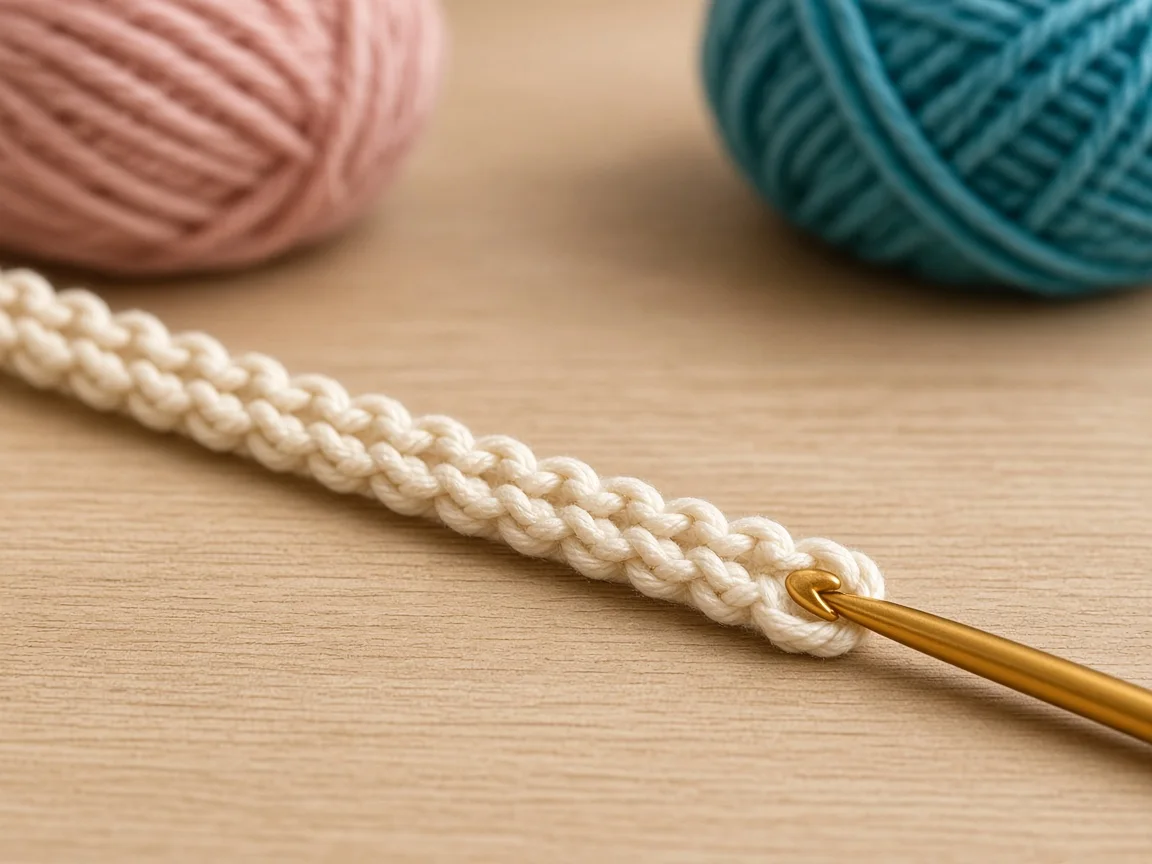
If holding the hook was the handshake, the chain stitch is the first sentence. Learn it with a pale yarn so you can see each loop clearly — cream, blush, or a quiet yellow.
A good chain looks like a braid of little V shapes. If yours looks like a string of knots, we will loosen the grip. If it looks like a sagging necklace, we will add a touch more tension. Both are normal on night one.
What a chain actually is
Look closely at a finished chain and you will see it has two faces. The front is a neat row of V shapes, one V per chain. The back has a single ridge of little bumps running down the middle, one bump per chain. This matters later: when a pattern says to work into the foundation chain, your hook can go under the two top legs of the V, or into the back bump, and each choice leaves a different edge. For now, just learn to see the two faces. Makers who can see their chains stop fearing them.
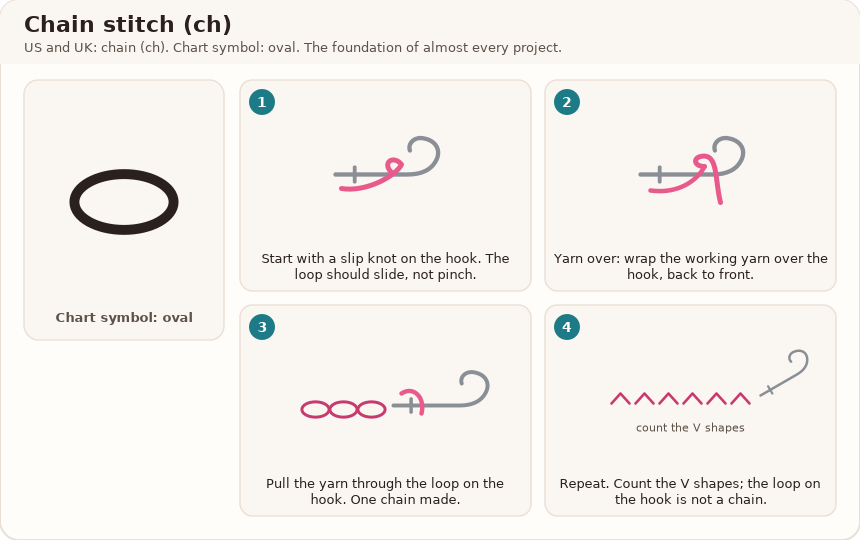
One counting rule before we start: the loop sitting on your hook is never counted. It is the working loop, the pen in your hand — not a word you have written. When a pattern asks for 20 chains, it wants 20 V shapes below the hook.
The steps, slowly
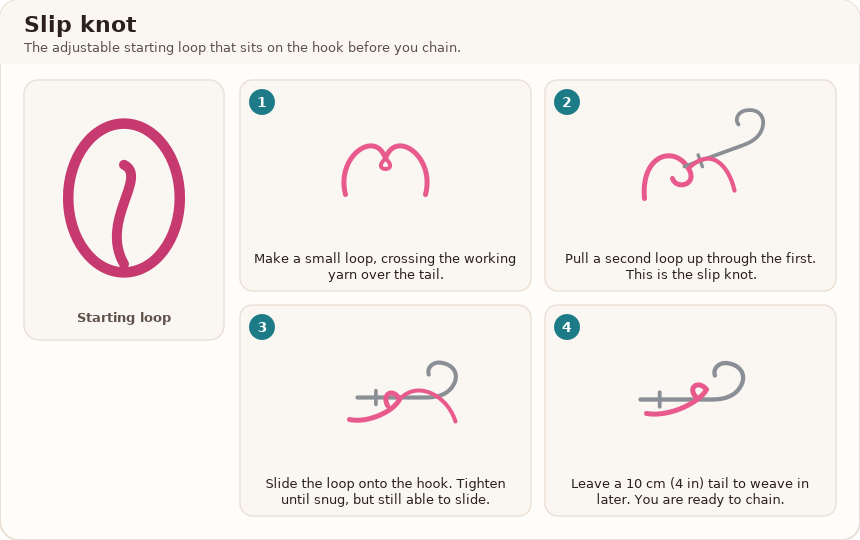
- Make a slip knot and slide it onto the hook. The knot should be snug enough to stay, loose enough to dance. Leave a tail of about 10 cm; you will weave it in later, and short tails are nobody’s friend.
- Yarn over — hook under the yarn, scoop, and draw that new loop through the loop already on the hook. That is one chain. Say it as you do it the first fifty times: yarn over, pull through. The rhythm is the lesson.
- Keep the thumb and middle finger of your yarn hand pinching the chain just below the hook. Move that pinch forward every few stitches so the work does not twist. That pinch is your tension’s home address — the chain is formed at the pinch, not up in the air.
- Make twenty chains. Stop. Look at them. Are the V shapes similar in size? If three are tiny and two are huge, you are changing your mood mid-row. Breathe and make twenty more.
- Count them out loud, touching each V with the hook tip. Counting is a kindness you do for future you. When you can make a chain that lies mostly flat, you have a foundation.
How tight is tight enough?
Here is a simple test. A finished chain stitch should slide easily when you push it along the hook’s shaft, and the hook should slip back through the loop without a fight or a wiggle. If you have to wrestle, it is too tight. If the loops gape like a loose necklace, it is too loose.
Almost every beginner chains too tight, not too loose. Gripping is what hands do when they are concentrating. The fix is not to try harder at being loose — it is to form each chain a little higher on the hook’s shaft, where the metal is full width, instead of out at the narrow tip. Chains made on the shaft come out even almost by accident.
And one kindness for later: your foundation chain can be made with a hook one size larger than the hook the project will use. Work the chain with the big hook, then switch. The first row stops being a wrestling match, and nobody can tell by looking. Many experienced makers do this on every single project.
The ladder at the end of the row: turning chains
The chain has a second job. When you finish a row and turn around to work back, you first chain a few stitches to lift the hook to the height of the new row. That little ladder is called the turning chain, and its height matches the stitch you are about to make:
- Single crochet: chain 1 (and in most modern patterns it does not count as a stitch).
- Half double crochet: chain 2.
- Double crochet: chain 3 (this one usually does count as the first stitch of the row).
- Treble crochet: chain 4.
Whether the turning chain counts as a stitch changes where your first and last stitches land, which is why two makers can follow the same pattern and end a stitch apart. When a pattern matters, it will tell you. When it does not tell you, assume single crochet chains do not count and double crochet chains do, and count your stitches at the end of the row to be sure.
A small practice plan
Evening one: chain 20, pull it out, chain 20 again. Three rounds of this. You are not wasting yarn; you are teaching your pinch hand its job.
Evening two: chain 30 and measure the middle. Then chain 30 again and try to match that same measurement without looking at the first one. Landing within a centimeter of yourself is real progress.
Evening three: chain 26 and work a row of single crochet into it. That wobbly first row is the doorway to every project on this site. The chain stops being practice and becomes a foundation the moment something grows out of it.
If this happens
Your chain corkscrews. Usually the hook is turning in your hand as you work. Keep the throat of the hook facing you, like a little smile, and let the pinch hand hold the chain flat.
The first chains are big and the last ones are tiny. Tension climbs as concentration climbs. Slow down around chain ten, drop your shoulders, and form each new chain at the same place on the hook’s shaft.
One giant chain hides in the middle. Your yarn over scooped air instead of yarn, and the loop below stretched to cover it. It is easier to pull back to the mistake than to hope a later row forgives it.
The chain is too short for the pattern. This happens to everyone, and it has a happy workaround: chain a few more than the pattern asks. Work your first row into the chains you need, and the spare chains at the starting end can be carefully unpicked later, leaving a tail to weave in. Far kinder than frogging a whole row.
A stitch refuses to let the hook through later. Those chains were too tight. Go up a hook size for the foundation only — now you know why that trick exists.
Frequently asked questions
Does the loop on my hook count as a chain?
No. The loop on the hook is the working loop and is never counted. Count only the V shapes below the hook. If a pattern says chain 20, you should be able to count 20 Vs.
Why do patterns tell me to work into the second chain from the hook?
For single crochet, the first chain next to the hook acts as the turning chain, which lifts the yarn to the height of the stitch. Skipping it keeps the edge straight. Taller stitches skip more chains: usually 2 for half double crochet and 3 for double crochet.
Should I work into the top loops or the back bump of the chain?
Either is correct. Working under the top loop (or two top loops) is the most common way and is easiest for beginners. Working into the back bump takes a little more care but leaves a neat edge that looks like the top of a row, which is nice for blankets and scarves.
My foundation chain is too tight to work into. What can I do?
Make the chain with a hook one or two sizes larger than your project hook, then switch to the project hook for the first row. Also make each chain on the wide shaft of the hook, not on the narrow tip.
How do I count a long foundation chain without losing my place?
Place a stitch marker or a scrap of contrasting yarn every 10 or 20 chains as you go. Then you only need to count in small groups.
A last note from the sofa
Leave this chain on the table tonight. Tomorrow we will turn it into single crochet, which is where the fabric finally appears.
Comments
No comments yet. Questions, corrections, and notes from your own attempt are welcome.