Stitches · Beginner
How to Crochet a Double Crochet Stitch That Looks Even
Tired of wavy edges and gaps in your double crochet? This tutorial will teach you how to make each stitch uniform, so your projects look neat and professional.
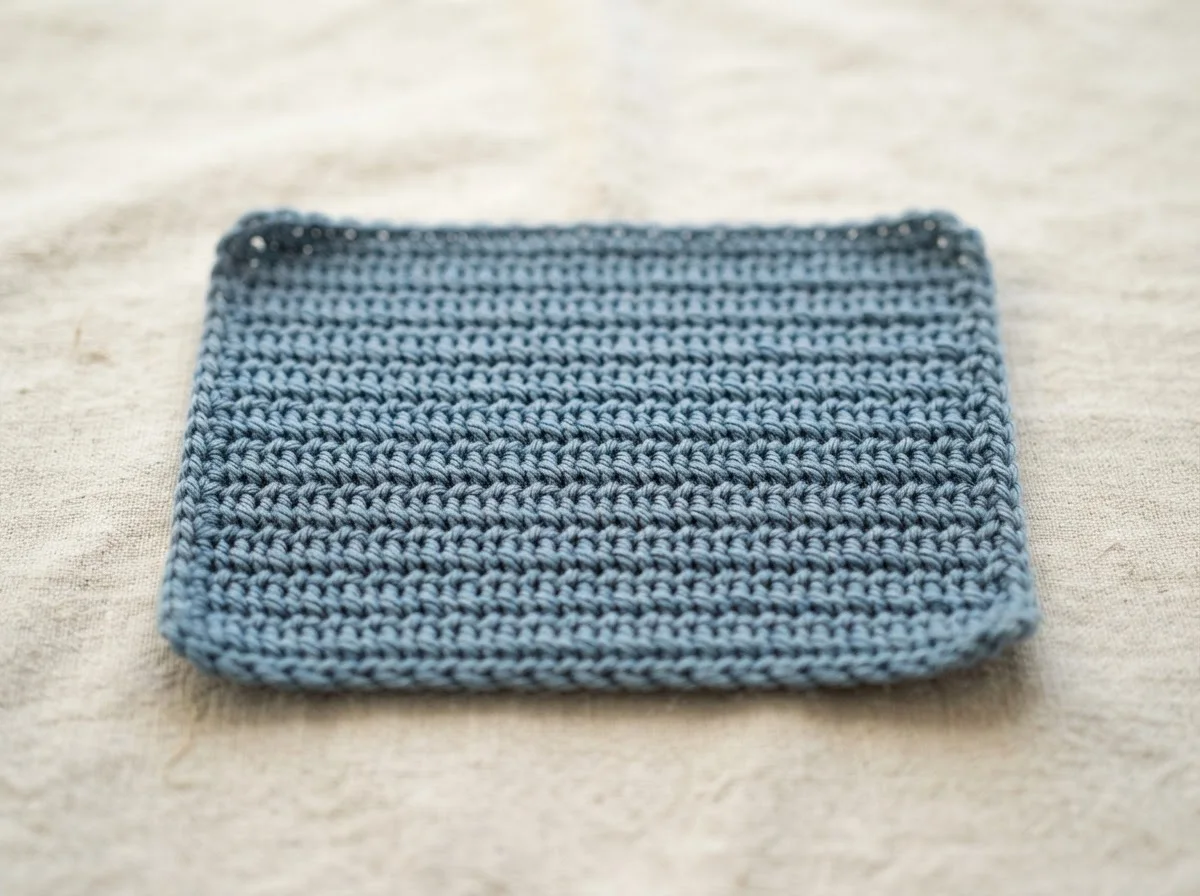
First rows of double crochet often look like a picket fence on a hill: tall, short, gappy, then suddenly tight. That is rarely a talent problem. It is inconsistent height on the first pull-up loop, plus soft counting at the turning chain. This lesson builds even US double crochet (UK treble) with a measured swatch and a clear rule for the row ends.
Target fabric — know what “even” looks like
Work a practice cloth in worsted / category 4 yarn with a 5.0 mm (H/8) hook. After a light steam or wet block, you want roughly 14–15 double crochet stitches and 8–9 rows in 4 inches. Edges should lie flat. A wave along the sides usually means stitch height changed mid-row; a triangle shape means you gained or lost stitches at the ends.
- Yarn: worsted (4), light color so stitches read clearly — about 40 yards
- Hook: 5.0 mm (H/8); size up if you crochet tight, size down if your fabric looks net-like
- Notions: stitch marker, ruler or gauge window, tapestry needle
- Swatch: 20 stitches wide × 10 rows tall
- Time: 30–45 minutes of focused practice
You should already make a slip knot, chain, and single crochet. Double crochet adds height; it does not replace those basics.
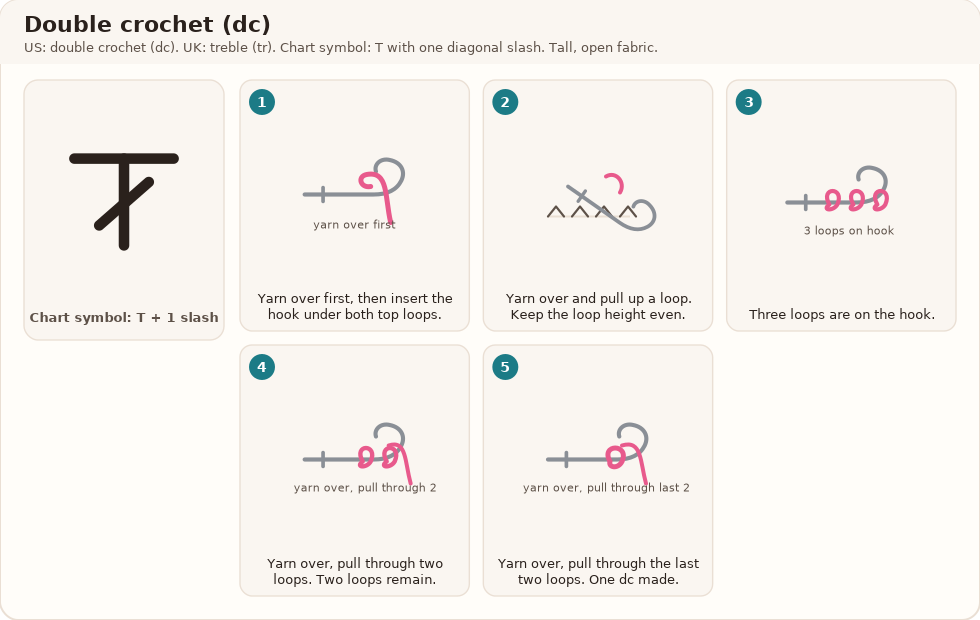
Four motions, one height you can feel
Yarn over. Insert the hook. Pull up a loop. Yarn over, pull through two loops. Yarn over, pull through the last two. The motion everyone rushes is the pull-up. That first loop should stand about as tall as a finished double crochet — on worsted yarn, roughly the width of your thumbnail. Short pull-ups make squat, stiff fabric. Tall, lazy pull-ups make holes and a soft, uneven lattice.
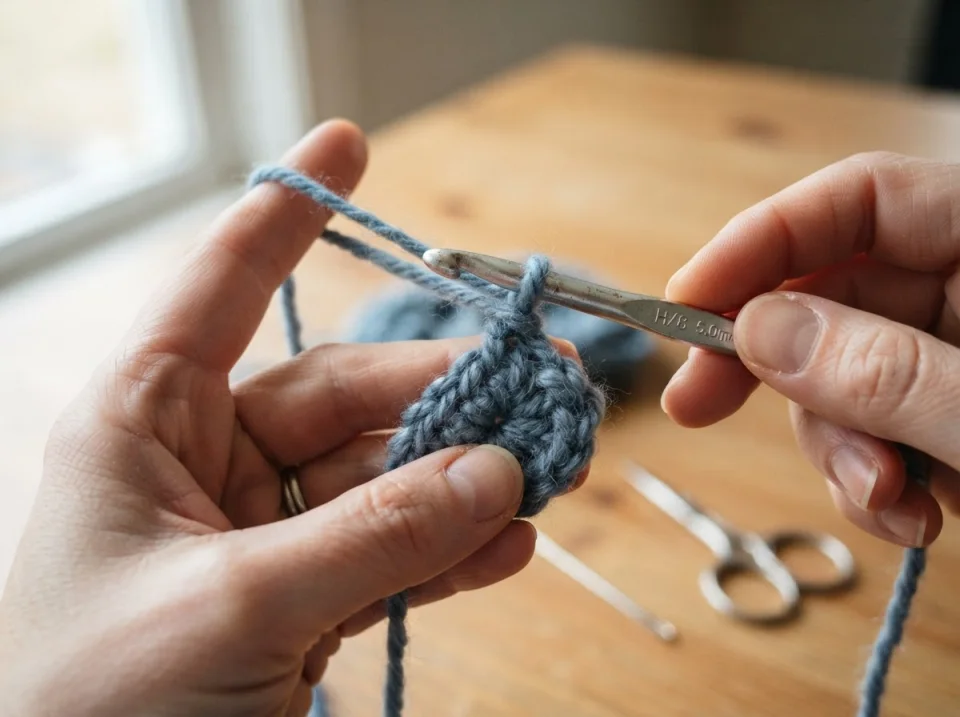
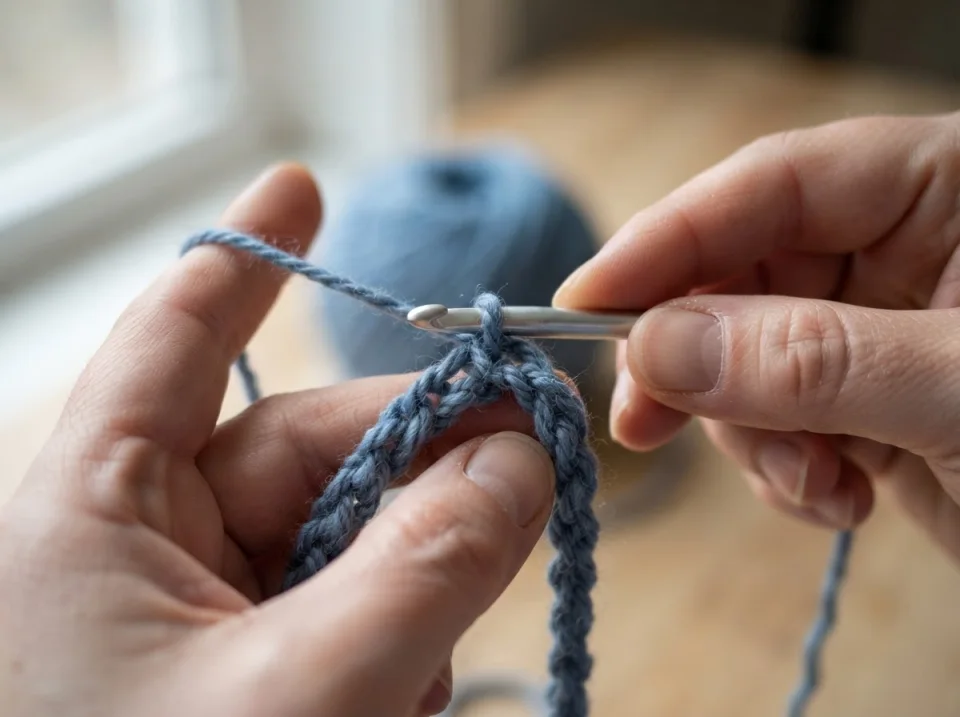
Keep the yarn-over wraps on the hook from twisting into a snarl. If the hook throat is facing the wrong way when you pull through, loops tighten unevenly and the stitch leans.
Foundation chain that does not choke row 1
Chain 23 loosely. If your chains always run tight, chain 21 with a hook one size larger, then switch back to 5.0 mm for the stitches. Work the first double crochet into the fourth chain from the hook. For this swatch the turning chain counts as a stitch, so row 1 ends at 20 double crochets.
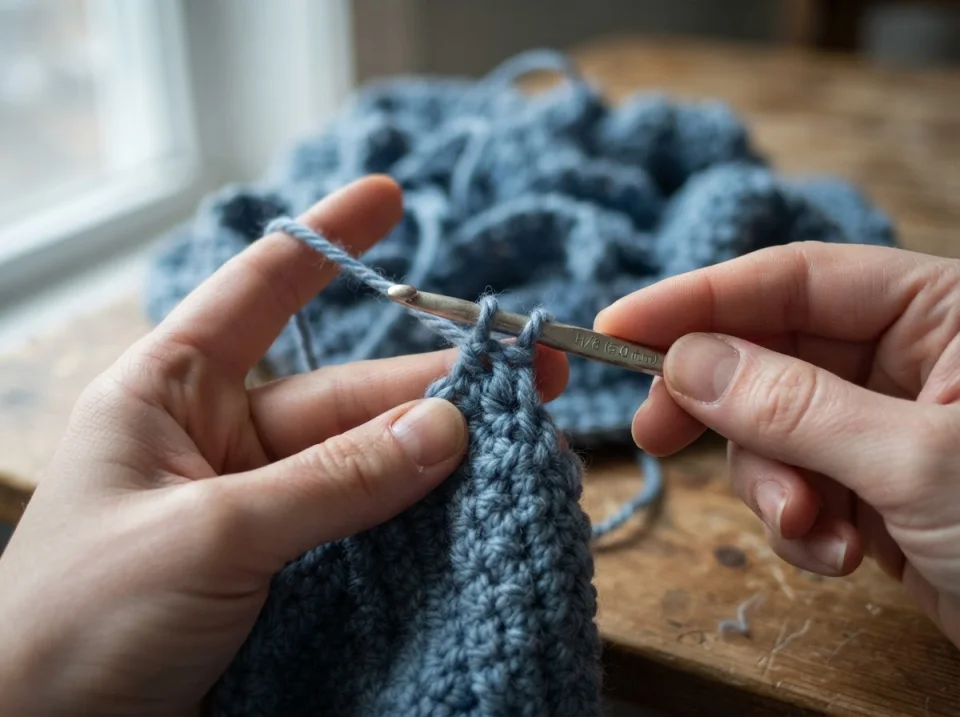
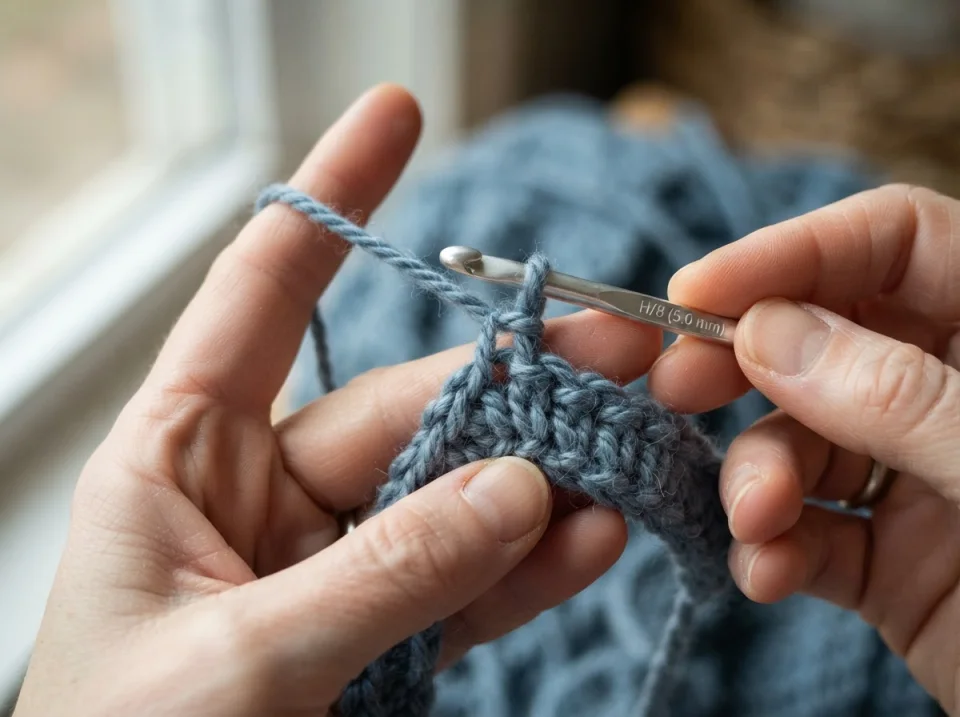
Insert under the top two loops of each chain when you can; some crafters prefer the back bump for a cleaner bottom edge. Either system is fine — pick one for the whole swatch.
Turning chain: pick a system and do not mix it
At the end of row 1, chain 3 and turn. Mark the third chain of that turning chain immediately. On row 2, skip the stitch at the base of the chain-3 (because the chain already stands in for it), double crochet across, and put the last stitch into the marked top of the previous turning chain.
That last placement is where scarves quietly become triangles. If you miss the turning-chain top, the row shrinks. If you also work into the space beside it, the row grows.
Alternatives when you hate the gap that a chain-3 leaves:
- Chain 2 that does not count — work a real double crochet into the first stitch of the row.
- Stacked single crochet — single crochet, then single crochet into the side of that stitch to build height without a hollow chain.
- Chainless standing double crochet — useful for color changes at row edges.
Choose one method per project. Mixing methods mid-blanket shows as a bumpy edge that blocking only partly hides.
Ten-row evenness drill
- Work 10 rows of exactly 20 double crochets.
- Count aloud at the end of every row until counting feels automatic.
- Every three rows, lay a ruler across the tops of the stitches. They should read like fence posts, not stairs.
- If the piece narrows, you are skipping the first or last stitch — remarker the turning-chain top.
- If the piece widens, you are treating a chain space as an extra stitch.
- Give each finished row a gentle horizontal tug — not a yank — to settle loops before the next row locks them in.
Photograph or keep the swatch. It is your personal gauge note for worsted double crochet on that hook.
Problems and precise fixes
- Wavy side edges: pull-up height changed during the row. Pause mid-row and match the new loop to the stitch you just made before you yarn over again.
- Gaps between stitches: fabric too loose, or hook inserted only under the front loop. Use both top loops; try a smaller hook.
- Cannot force the hook into the next stitch: tension too tight or hook too small. Size up; stop pulling the final pull-through like you are setting a knot.
- First stitch of the row looks skinny: normal for a chain-3 start. If the hollow bothers you, switch to stacked single crochet or a non-counting chain-2 system for the next project.
- Fabric slants like a parallelogram: almost always end-of-row counting. Markers beat memory.
UK and US names (avoid the classic trap)
US double crochet = UK treble (tr). The UK term “double crochet” is US single crochet. If a pattern’s fabric looks twice as dense as the photo, check which term system it uses before you rip a finished square.
From swatch to something useful
A 20-stitch by 10-row swatch is already washcloth-sized. Weave the ends, or keep going for a short scarf panel: for about 6 inches of width at this gauge you stay near 20–22 stitches; for adult length, work until the piece reaches roughly 60 inches, then add a simple single-crochet border if the edges still look informal.
Even double crochet underpins scarves, blankets, mesh bags, and many wearables. Get the height honest on a small cloth and those projects stop inheriting a wavy edge you then try to “fix” with blocking alone.
Hand and yarn control that keeps height steady
Hold the working yarn so the feed is consistent: many makers wrap it over the index finger of the non-hook hand with light friction from the other fingers. If the yarn suddenly runs loose for three stitches and tight for three, your double crochets will telegraph that pulse as tall-short-tall fabric.
Rest your elbows. Hovering shoulders creep tension upward across a long row. When you feel your grip tighten, set the hook down for thirty seconds and resume on the same stitch — do not “push through” a tension spike or you will spend later rows trying to hide it.
Light-colored matte yarn shows mistakes early, which is what you want while learning. Dark variegated yarn hides uneven height until the piece is a foot long; save those skeins for after the swatch drill feels boring.
Reading your swatch like a diagnostic chart
Fold the finished 20-by-10 swatch in half along the rows. The two halves should meet without a banana curve. If one side is longer, your tension changed when you were tired or distracted — note which rows look different and remake those habits on the next cloth rather than “averaging” with blocking.
Count stitches along a ruler at three places: near the start of a row, mid-row, and near the end. Matching counts with mismatched width mean loop height changed while stitch count stayed honest. That is a hand problem, not a pattern problem, and it is exactly what this drill trains.
Keep a tag with the yarn name, hook size, and measured gauge pinned to the swatch. Future scarves and blankets in the same yarn skip the guesswork. When you switch brands of “worsted,” redo a mini swatch — two brands labeled 4 can differ by a full stitch per four inches.
If you plan colorwork stripes later, practice carrying yarn up the side on a second swatch. Uneven double crochet plus carried floats creates a wavy edge that borders struggle to hide. Get the solid-color cloth honest first.
#double crochet #crochet tutorial #beginner crochet #crochet stitches #even stitches #crochet tips
Comments
No comments yet. Questions, corrections, and notes from your own attempt are welcome.