How to Crochet the Puff Stitch (Easy Puff Stitch Dishcloth)
Learn the crochet puff stitch step by step, keep every puff the same size, and practice it with an easy 30-stitch puff stitch dishcloth in worsted cotton. Includes variations, troubleshooting and FAQ.
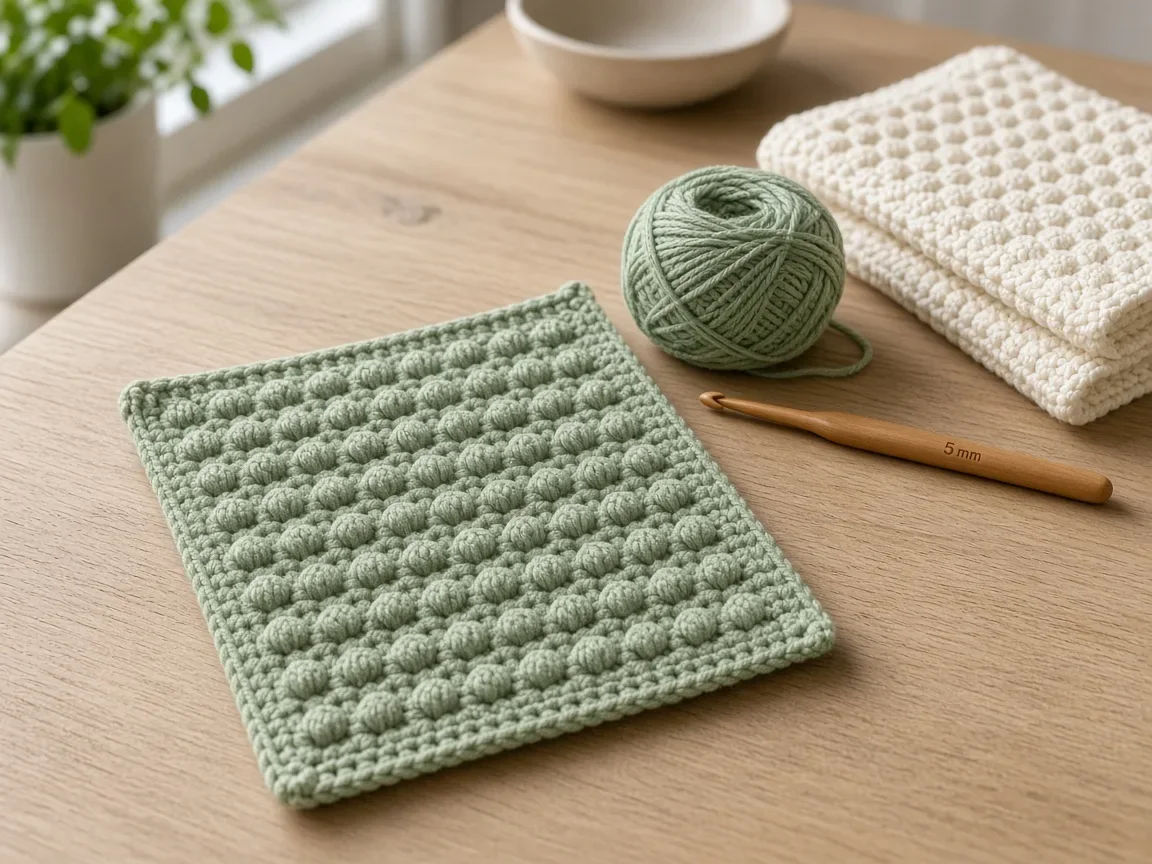
The puff stitch is one of the friendliest textured stitches in crochet. You pull up several long loops in the same stitch, close them together, and get a soft, rounded bump that looks far more advanced than it is. It shows up in blankets, hats, cowls, and dishcloths, and once you can make one neat puff you can read a huge number of patterns that use it.
This tutorial explains exactly how to make a puff stitch, how to keep every puff the same size, and how to work it in rows. Then you will put it into practice with a simple puff stitch dishcloth that uses only puffs, chains, and single crochet. It makes a quick handmade gift, too: a pair of cotton cloths tied with ribbon is a classic holiday present.
Before You Begin
Skills needed: chain, single crochet, and half double crochet. If any of those are new, start with single crochet step by step and half double crochet for soft, fast fabric. The puff stitch is built on the same "yarn over, pull up a loop" motion as half double crochet, just repeated.
Abbreviations (US terms): ch = chain, sc = single crochet, hdc = half double crochet, yo = yarn over, sl st = slip stitch, st(s) = stitch(es), sk = skip, sp = space, puff = puff stitch (defined below). Numbers in brackets are the stitch count at the end of the row.
What Materials Do You Need?
- Worsted weight (#4) cotton yarn, about 90 to 110 yd (82 to 100 m) for one dishcloth. Cotton holds the puff shape well and is absorbent for kitchen use.
- 5.0 mm (US H-8) crochet hook
- Yarn needle and scissors
- Optional: a stitch marker for the first stitch of a row
Smooth, light-colored yarn is the easiest choice for learning, because you can see each loop clearly. Fuzzy or very dark yarn makes the loops hard to count. A hook with a slightly pointed, deep throat helps a lot, because you will be holding up to nine loops at once. For help matching yarn and hook, see how to choose yarn weight and hook size.
Gauge: not critical for a dishcloth. As a guide, worsted cotton with a 5.0 mm hook usually gives about 14 to 16 sc per 4 in (10 cm). If you want a specific width, crochet a small swatch and run it through the crochet gauge calculator.
How to Make a Puff Stitch
A puff stitch is a group of long, unfinished loops pulled up in one stitch and closed together. This tutorial uses a four-loop puff, which is the most common size.
- Yarn over and insert the hook into the stitch.
- Yarn over and pull up a loop. Lift that loop up to about the height of a half double crochet, roughly 1/2 in (1.3 cm). You now have 3 loops on the hook.
- Repeat steps 1 and 2 three more times in the same stitch, lifting each new loop to the same height. You now have 9 loops on the hook.
- Yarn over and pull through all 9 loops.
- Ch 1 to lock the puff closed. This small chain is the top of the puff.
Tip: hold the base of the loops against the hook with your index finger as you work. This stops the earlier loops from shrinking while you pull up the later ones, which is the main reason puffs come out uneven.
Puff vs. Bobble vs. Popcorn
These three stitches look similar but are built differently. A puff is made of loose loops with no stitches completed until the end, so it is soft and flat-ish. A bobble is several unfinished double crochets closed together, which makes a firmer bump. A popcorn is several complete double crochets that are folded and joined at the top, which makes the most raised and dense shape. If a pattern says "puff," use the loop method above.
Puff Stitch Dishcloth Pattern
This cloth alternates a row of puffs with a row of single crochet. The puffs stack directly above each other, making neat columns of bumps. The foundation is a multiple of 2 plus 1, so you can widen or narrow it easily.
Finished size: about 8 in (20 cm) square before the border, and about 8.5 in (21.5 cm) with the border. Your size will vary with yarn and tension.
- Foundation: ch 31.
- Row 1: sc in the 2nd ch from the hook and in each ch across, turn. [30 sc]
- Row 2 (puff row): ch 2 (does not count as a st), puff in the first sc, *ch 1, sk the next sc, puff in the next sc*; repeat from * to * until 1 sc remains, hdc in the last sc, turn. [15 puffs, 14 ch-1 sps, 1 hdc]
- Row 3 (sc row): ch 1, sc in the first hdc, *sc in the top of the next puff, sc in the next ch-1 sp*; repeat from * to * 13 more times, sc in the top of the last puff, turn. [30 sc]
- Rows 4 to 23: repeat Rows 2 and 3 ten more times, or until the piece is about as tall as it is wide. End with a Row 3. [30 sc]
Count your stitches at the end of every sc row. If you keep landing on 29 or 31, check the first and last stitches of the row, which are the easiest to miss. The guide on how to count crochet stitches and rows shows how to find the top of each stitch.
Border and Finishing
- Border: do not turn. Ch 1 and work sc evenly down the side, placing 1 sc in the end of each sc row and 2 sc in the end of each puff row. Work 3 sc in each corner. Continue along the foundation edge with 1 sc in each ch, then up the second side and across the top in the same way. Join with a sl st to the first sc.
- Fasten off, leaving a 6 in (15 cm) tail.
Weave in both tails through several stitches, changing direction at least once so they stay put through washing. The tutorial on weaving in crochet ends so they never pop out walks through the method. If the edges ripple, wet the cloth, pin it square, and let it dry flat, as explained in how to block crochet pieces.
Sizing and Variations
Change the width: chain any odd number. Row 1 then has an even number of sc, and every puff row ends with one hdc. For a bigger washcloth, ch 41 for 40 sc and 20 puffs.
Thinner or fuller puffs: pull up 3 loops instead of 4 (7 loops on the hook) for a smaller, flatter puff that suits lightweight yarn. Pull up 5 loops (11 loops on the hook) for a chunkier bump. Keep the same number in every puff for an even texture.
Use it elsewhere: the same puff row makes a lovely textured band on a scarf or cowl. You can also pair the dishcloth with the textured spa washcloth for a gift set.
Troubleshooting
- Puffs are different sizes: you are pulling some loops higher than others. Pinch the loops against the hook and aim for the same height each time. Saying the count out loud ("one, two, three, four") also helps.
- The hook will not pass through all the loops: the loops are too tight. Pull each one up a little taller, use a hook with a smooth, tapered head, or go up half a size.
- Holes beside the puffs: the ch-1 between puffs is too loose, or you skipped two stitches. Keep the ch 1 snug and skip only one sc.
- The cloth slants or gets narrower: the last stitch of a row is being missed. Mark the hdc at the end of each puff row so you remember to sc into it on the way back.
- Puffs lean to one side: this is normal. Puffs naturally tilt slightly in the direction you work, and because the rows alternate direction, the fabric evens out.
Frequently Asked Questions
Is the puff stitch good for beginners?
Yes, once you are comfortable with half double crochet. It is a repeat of a motion you already know, and a dishcloth is small enough to finish while you practice keeping the loops even.
Does the ch 1 after a puff count as a stitch?
No. The ch 1 that locks the puff is part of the puff itself. In this pattern, you work your single crochet into that locking chain, which sits on top of the puff. The separate ch 1 between puffs creates the space you work into on the next row.
How much yarn does the puff stitch use?
Quite a lot compared with single crochet, because each puff holds several long loops. Plan on more yarn than a plain sc cloth of the same size. Buy an extra ball for larger projects such as a blanket.
Can I work the puff stitch in the round?
Yes. Many hats and circular coasters use puffs separated by chains, worked into the stitches or spaces of the previous round. Begin each round with ch 2 and join to the top of the first puff.
What yarn is best for a puff stitch dishcloth?
100% cotton or a cotton-linen blend in worsted weight. It is absorbent, holds the puff shape, and can usually be machine washed. Always check the care label on your yarn.
#puff stitch #crochet stitches #beginner crochet #cotton yarn #crochet dishcloth #easy crochet
Comments
No comments yet. Questions, corrections, and notes from your own attempt are welcome.