Beginner Basics Stitches · Beginner
Single Crochet Step by Step for Absolute Beginners
Single crochet is the first stitch that feels like cloth. Short, sturdy, and honest — Beginners use it more often than fancy lace.
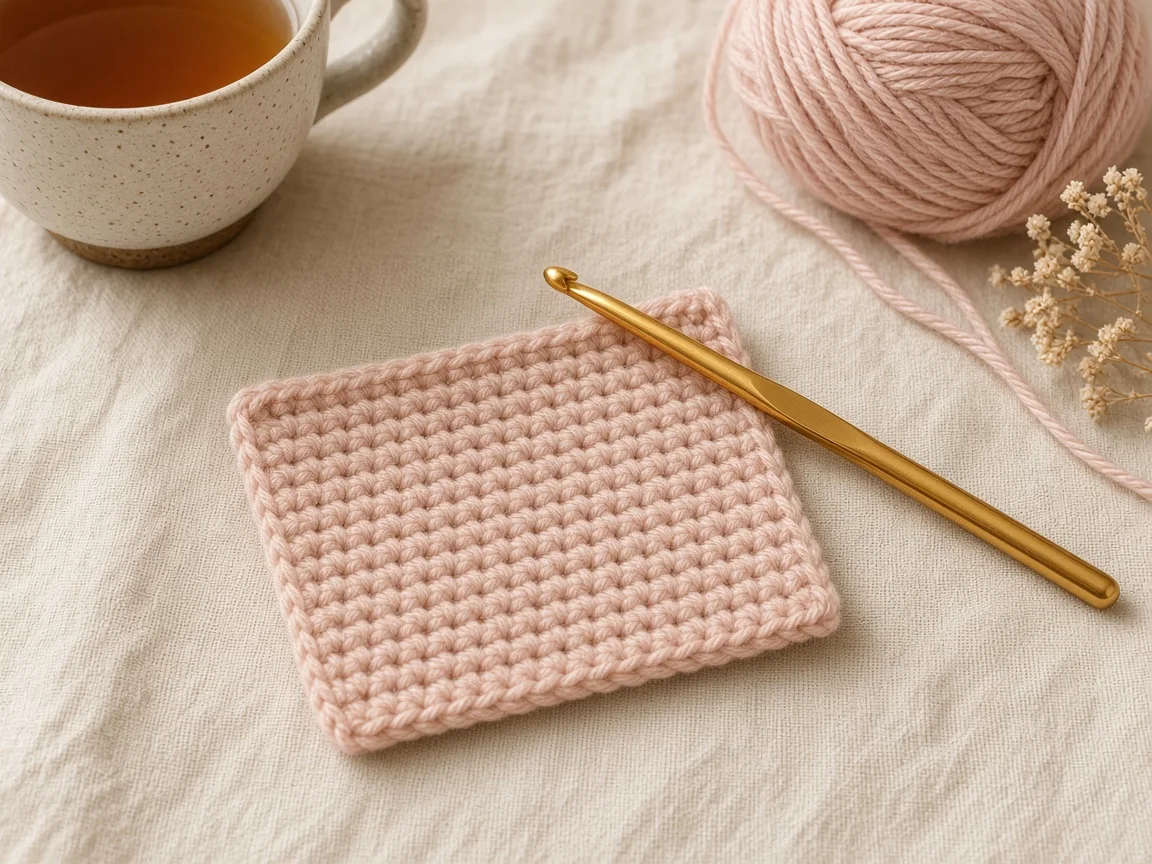
The first time a row of single crochet lines up, it is a small thrill. It is not beautiful yet, but it is fabric. You can fold it. You can ruin it and still know you made something.
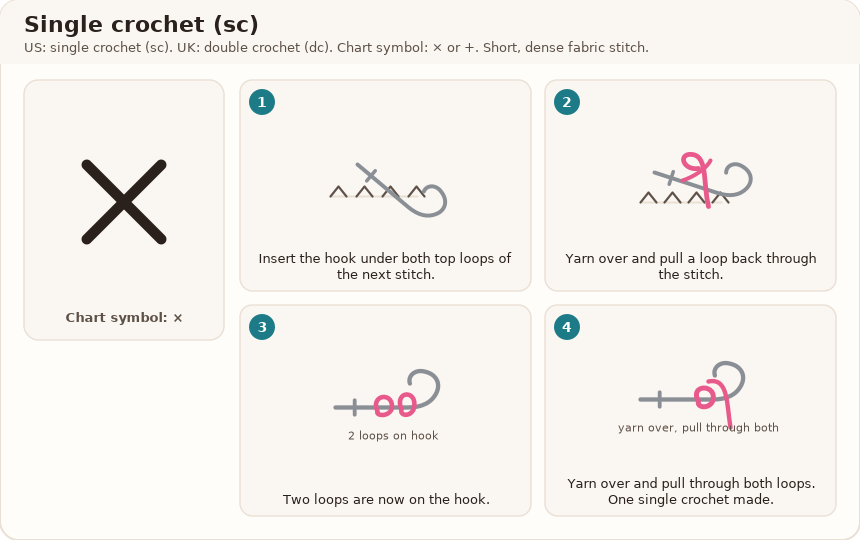
Single crochet (sc) is short. The hook goes into a stitch, yarns over, pulls up a loop, yarns over again, and pulls through both loops. That is the whole poem. We will walk it slowly, because the place you insert the hook matters more than speed.
Where the hook goes
Every stitch from the row below wears a little V on its top — two legs, a front leg and a back leg. The standard single crochet goes under both legs. That is the version to learn first, and it is what patterns mean when they say nothing special.
Two variations are worth knowing by name, because patterns will ask for them later. Work into the front loop only and the row leaves a little ridge of unused back loops behind it. Work into the back loop only and you get a stretchy, ribbed fabric that springs back when you tug it — that is how simple cuffs and headband bands are born. Same stitch, three fabrics, decided entirely by where the hook goes in.
The steps, slowly
- Chain 16. The last chain is a turning chain and does not count as a stitch. Turn the work so the hook is on the right if you are right-handed.
- Skip that first turning chain. Insert the hook under both top loops of the second chain from the hook. You will see a little V. Go under both legs of it.
- Yarn over and pull a loop back through. You now have two loops on the hook.
- Yarn over again and draw through both loops. One single crochet is born. The remaining loop should sit comfortably, not cinched.
- Repeat across the row. At the end you should have 15 stitches. That count — 15, not 14, not 16 — is your first real quality check. Count the V shapes along the top, one per stitch.
- Chain 1 and turn. Here is the detail that saves more scarves than any other: your first stitch of the new row goes into the first stitch of the row below — the stitch sitting right at the base of your turning chain. It hides there, shy, and skipping it is the number one reason edges slope inward. The chain-1 for single crochet does not count as a stitch, so nothing has taken that stitch’s place. It is waiting for you.
- Work a single crochet into every stitch across, including the very last one, which also likes to hide — it sits a little lower and further over than you expect. When in doubt, count: 15 out means 15 back.
- Make a swatch of 8 to 10 rows. This is your first field of fabric. Keep it. Date it on a scrap of paper.
Counting without tears
Count stitches, not hopes. At the end of each row, run the hook tip along the top edge and touch each V: one V, one stitch. If counting every row feels fussy, put a stitch marker — or a scrap of contrasting yarn, or a safety pin — in the first and last stitch of the row. The markers move up with you, and the two edge stitches can never go missing while they are wearing jewelry.
Rows are counted by the ridges. Single crochet stacks in neat horizontal lines; count the lines of V tops from the foundation row up, and that is your row count. When a project says “work until it measures 20 cm,” believe the tape measure over the row count. Your hands are not the designer’s hands, and that is fine.
Reading your swatch
Hold your finished swatch up to the light. Single crochet makes the densest fabric of the basic stitches — small stitches, no holes to speak of, a surface like woven cloth. That density is why it is the stitch of amigurumi, baskets, and anything that must hold its shape.
If you want a number for it, measure the middle of the swatch, not the edges: count how many stitches and rows fit in 10 cm (4 in). That is your gauge, and it will follow you through every pattern that says “gauge: 18 sc = 10 cm.” If your number is bigger than the pattern’s, your work will come out smaller — go up a hook size and swatch again. Ten minutes of swatching saves more projects than almost any other habit.
Expect the edges of a plain swatch to curl a little toward you. That is single crochet’s nature, not your failure. A border, a few rows of a taller stitch, or gentle blocking will talk it flat when it matters.
Your first real project: a dishcloth tonight
You know enough already. Take cotton yarn — cotton, because it drinks water and forgives the washing machine — and a 5 mm hook. Chain 26. Work single crochet in the second chain from the hook and across (25 stitches). Chain 1, turn, and repeat until the cloth is square, about 24 to 26 rows. Fasten off, weave the two ends, and put it by the sink. It will be slightly imperfect and completely useful, which is the correct order for first projects.
If this happens
The edges pull in. You are skipping the first or last stitch of the row. Put a stitch marker in the first stitch of every row for a week, and remember the last stitch hides lower than you think.
The edges flare out. You are accidentally adding a stitch in that same hiding place — usually by working into the turning chain as if it were a stitch. For single crochet it is not. Count to 15 and trust the count.
The first row was a wrestling match. Your foundation chain was tighter than your stitches. Make the chain with a hook one size larger, then switch back. Nearly everyone’s chain hand is tighter than their stitch hand.
The hook splits the yarn. You are catching half the strand on the way through. Slow down at the insertion, and push the hook through in one motion instead of wiggling it. Softly twisted yarns split less once your hands relax.
Your fabric leans like a parallelogram. Each stitch is landing a fraction off because the turning is rushed. Turn the work fully, look at the first stitch before you touch it, and let the row start calmly.
Frequently asked questions
Is single crochet the same in British patterns?
No, and this one matters. American single crochet is called double crochet in British patterns. If a pattern’s fabric looks suspiciously tall for “double crochet,” check whether it uses US or UK terms before you rip anything out.
Can I make toys with it?
Yes. Single crochet is the toy stitch. Worked with a hook a little smaller than the yarn label suggests, it makes the tight fabric that keeps stuffing from showing through on amigurumi.
Does the chain 1 at the start of a row count as a stitch?
For single crochet, almost never. Chain 1, turn, and work your first single crochet into the very first stitch of the row. If a pattern wants it counted, it will say so.
Why does my single crochet fabric slant or curl?
A slight curl is normal for a small swatch of single crochet and usually relaxes with a border or light blocking. A slant to one side is different: it usually means you are skipping the first stitch or adding one at the end. Count every row until the edges stay straight.
How many stitches should a beginner swatch have?
About 15 to 20 stitches and 8 to 10 rows is enough to settle your tension and measure gauge over 10 cm (4 in) in the middle of the swatch, away from the edges.
A last note from the sofa
When your swatch feels even enough to keep, you already know enough to make a dishcloth. That is a real project, and it counts.
Comments
No comments yet. Questions, corrections, and notes from your own attempt are welcome.