Patterns Beginner Basics · Beginner
How to Read Crochet Patterns Without Getting Lost
Patterns are just letters from one maker to another. Once you know the dialect, they stop feeling like a locked diary.
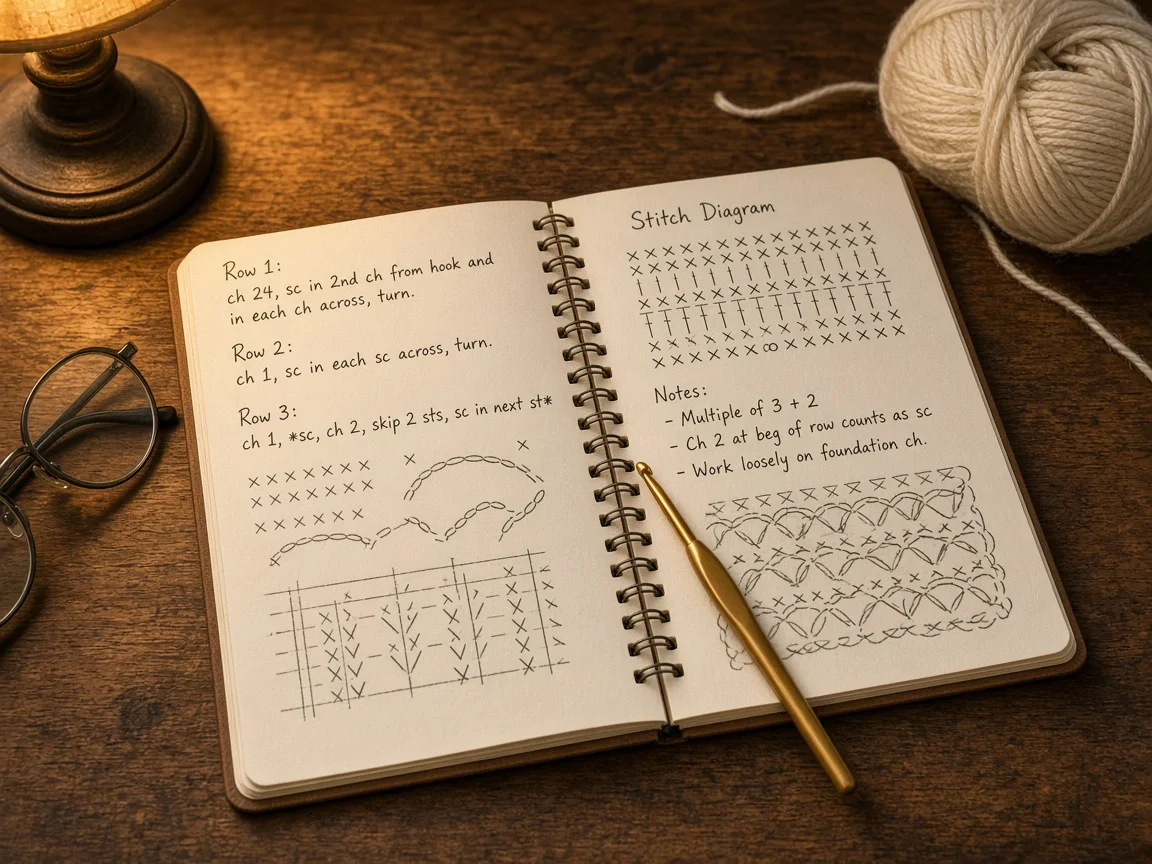
It is tempting to skip the abbreviations page like it was terms and conditions. Then you spend an hour working single crochet where the designer asked for half doubles, and wonder why the hat looks like a bowl.
Reading a pattern is a skill of its own, separate from making the stitches. We will walk through the usual header, the brackets, the asterisks, and the moment you should put the hook down and count.
Anatomy of a pattern: the header is the map
Before the first row, every decent pattern tells you six things. Read them all, in order, every time — they are the difference between a project and a frog pond.
- Difficulty. A promise about how much hand-holding the rows will do. Believe it.
- Finished size. The destination. If your version is heading somewhere else, better to know at row 3 than row 93.
- Materials and yardage. Not just yarn weight — how much of it. A substitution must match the weight and behave like the original fiber: cotton does not drape like wool, whatever the label says.
- Hook size. A starting suggestion, not a law. Your gauge decides the final answer.
- Gauge. The most-skipped paragraph in crochet. We will come back to it below, because it deserves its own moment.
- Abbreviations and notes. Where the designer admits their quirks: “turning chain does not count,” “work in back loops throughout,” “the stitch count changes on row 7.” Notes are where patterns hide their kindness. Read them twice.
The dialect: abbreviations that run everything
Patterns are written in a shorthand that feels like code until it suddenly feels like English. The core vocabulary is small:
- st / sts — stitch / stitches. ch — chain. sl st — slip stitch.
- sc — single crochet. hdc — half double crochet. dc — double crochet. tr — treble crochet.
- inc — increase (usually two stitches in one place). dec — decrease (two stitches worked into one). In amigurumi, inv dec is the invisible decrease.
- yo — yarn over. sk — skip. sp — space. rep — repeat.
- RS / WS — right side / wrong side of the fabric. BLO / FLO — back loop only / front loop only.
- MR — magic ring (you may also see “adjustable loop”). PM — place marker.
Everything else in a pattern is punctuation, and punctuation is grammar. An asterisk means start the repeat here. Brackets group stitches that travel together. Parentheses at the end of a row hold either a choice (sizes) or a verdict — the stitch count you should be holding. Believe the stitch count.
US or UK? The one-table warning
Here is the trap behind that bowl-shaped hat. American and British patterns use the same words for different stitches. American single crochet is British double crochet. American double crochet is British treble. The stitches climb a size as they cross the ocean.
Clues to which dialect you are holding: British patterns say tension where Americans say gauge, and they never use “single crochet” at all — if the words “single crochet” appear, it is American. Ten seconds of checking saves an hour of frogging.
The steps, slowly
- Read the whole pattern once without yarn. Highlight every abbreviation you do not love yet: ch, sc, hdc, dc, sl st, inc, dec, blo, flo.
- Note the gauge. If the designer says 14 dc = 10 cm and you get 16, your project will shrink. Change hook before you change yourself.
- Asterisks mean “repeat this bit.” Brackets often mean “do this all in one stitch” or “repeat this group.” Parentheses sometimes hold a stitch count at the end of a row. Believe the stitch count.
- Put a marker at the beginning of every round on circular work. Patterns assume you know where you started. Future you does not.
- When a line says “repeat from * 5 times,” do it slowly and tick the repeats. Speed is how mistakes hide.
Decode a real line, word by word
Here is a line from an imaginary hat, translated word by word:
Rnd 4: [Sc in next 3 sts, 2 sc in next st] 6 times. (30 sts)
Plain speech: Work one single crochet in each of the next three stitches, then two single crochets in the fourth stitch. Do that whole group six times. When you finish, count: you should have 30 stitches.
Now the arithmetic, because the arithmetic is the safety net. Each group turns 4 stitches into 5. Six groups: 24 stitches become 30. The number in parentheses matches, so you have read the line correctly. If your round ends at 29, the missing stitch is in this round, probably inside a group you rushed. Find it now, while the search area is one round deep.
Gauge: the paragraph everyone skips
Gauge is the designer saying, “my hands make stitches this big — match them, or your hat fits a different head.” Making the swatch properly takes fifteen minutes and is not optional for anything worn on a body:
- Make the swatch bigger than the gauge box — at least 15 cm square when the pattern measures 10.
- Wash and dry it the way the finished thing will be washed. Cotton relaxes, acrylic blooms, wool can grow. Measure after, never before.
- Count stitches across the middle 10 cm, away from the edges, which lie.
- Too many stitches in your 10 cm? Your stitches are small — go up a hook size. Too few? Go down. Then swatch again. Yes, again.
For a scarf or a blanket, gauge decides the finished width, which you can fudge. For a sweater, gauge decides whether it fits a person or a porch. Match it.
Keeping your place
Professional pattern-followers are not smarter; they are annotated. Print the pattern or photocopy it, and mark it without mercy: tick each finished row, circle the repeat you are inside, park a sticky note under the line you are on. A row counter — an app, a clicker, tally marks in the margin — turns “was that round 6 or 7?” from a crisis into a glance.
On rounds, a stitch marker in the first stitch is non-negotiable. Patterns are written as if the start of the round glows. In real yarn, in lamplight, at 11 p.m., it does not glow. The marker glows for it.
If this happens
The math at the end of a row does not match. Do not keep going hoping it will. Frog to the last place the count was honest. Patterns rarely gaslight you; skipped stitches do.
The pattern calls for a stitch you have never made. Stop one row early and learn it on scrap yarn, not inside the project. Ten practice stitches in junk yarn will protect ninety good ones.
Your count is right but the shape is wrong. You may be misreading a placement word — working into both loops where the pattern quietly said back loop only, or joining rounds the pattern meant to spiral. Re-read the notes page; the answer is usually hiding there in a sentence you skimmed.
You suspect the pattern itself is wrong. It happens — designers are human, and testers are too. Check the designer’s site for an errata list before you assume your hands failed. If the stitch count in parentheses cannot be reached by any honest reading of the line, the line, not you, needs the correction.
Frequently asked questions
What do the numbers in parentheses at the end of a round mean?
Usually the stitch count you should have when the round is finished, such as (30 sts). In patterns with several sizes, parentheses can also hold the numbers for the larger sizes, for example 40 (44, 48) sts. The pattern notes explain which style it uses.
What is the difference between brackets and asterisks?
Both mark a repeat. Brackets or parentheses group stitches that are repeated a set number of times, like [sc in next 2 sts, 2 sc in next st] 6 times. An asterisk marks where a repeat starts, and the line tells you how far to repeat, such as “repeat from * around.”
How can I tell whether a pattern uses US or UK terms?
Look for the words “single crochet.” They only exist in US patterns. UK patterns also tend to say “tension” instead of “gauge” and “miss” instead of “skip.” Most good patterns state the terms near the top.
Do I really need to check gauge?
For anything that has to fit (hats, gloves, sweaters), yes. For blankets, scarves, and dishcloths, gauge only changes the size and how much yarn you use, so you can be relaxed about it.
What does “work even” mean?
Work one stitch in each stitch, with no increases or decreases, so the stitch count stays the same.
A last note from the sofa
Keep a notebook of the patterns you have survived. The second one is always less frightening than the first.
Comments
No comments yet. Questions, corrections, and notes from your own attempt are welcome.