
Stitches · Easy
How to Change Colors in Crochet Without Loose Ends Taking Over
A clean color change is just finishing the last stitch with the new yarn. The rest is weaving, and weaving is how projects survive.
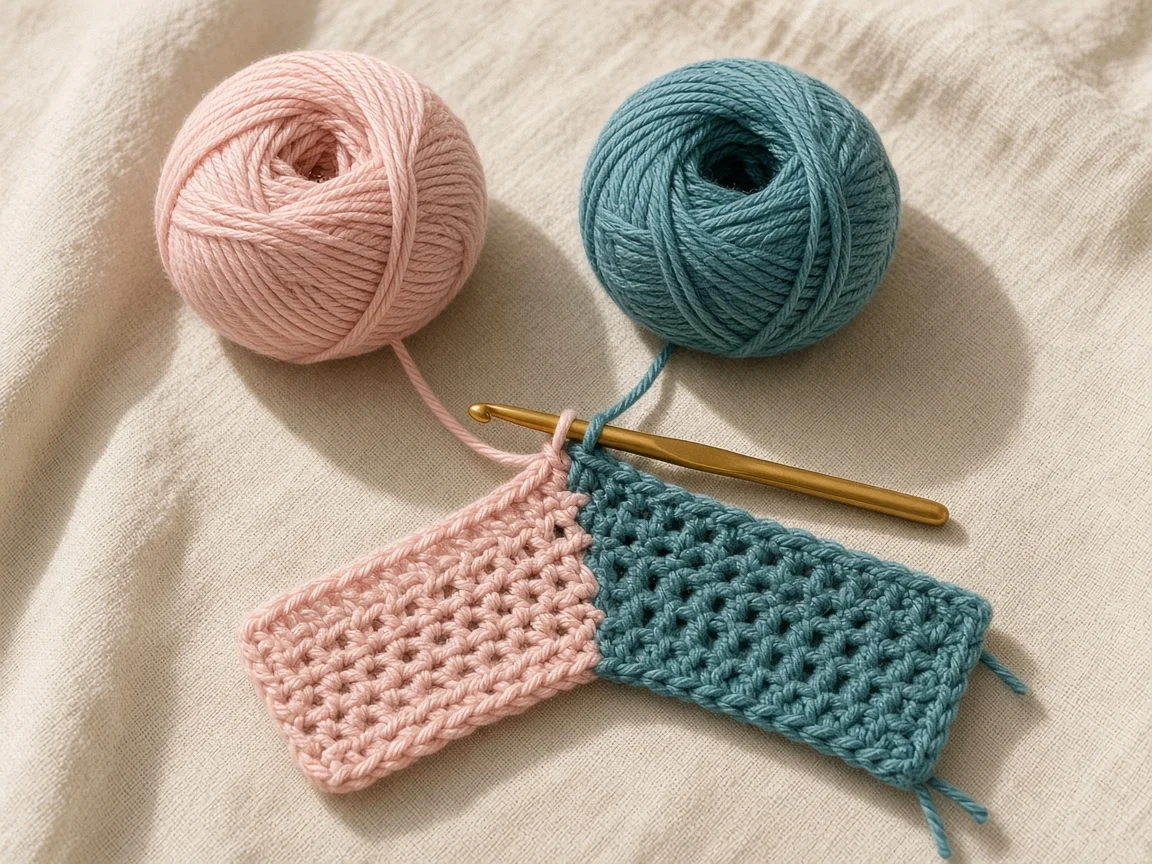
Tying colors together with little knots seems sensible, until the back of the work feels like a bramble and the knots start poking through. There is a kinder way, and it happens one yarn-over earlier than you think.
Whatever stitch you are in — single, half, double — you complete the last pull-through with the new color. The old color stays parked, ready to be woven or carried. Everything in this lesson is that one idea, unfolded.
Why the change happens one step early
Look at a finished stitch and you will see that its top — the V your hook enters next row — is made by the last yarn over you pulled through. The stitch below can be worked in the old color, but if the last pull-through uses the old yarn too, the top of the stitch shows the old color and the new color arrives one stitch late, looking like a smudge or a shadow.
So the rule: work the last stitch of the old color almost to the end, stop with the final loops still on the hook, and finish those loops with the new color. The stitch stands in the old color; its crown already wears the new one. The first full stitch of the new color then comes out clean.
The steps, slowly
- Work the stitch as usual until two loops remain on the hook (or three for half double, before that last pull-through). For double crochet, you will have done the first pull-through of two and be holding two loops.
- Drop the old color. Let it hang at the back of the work — do not cut it yet, and do not pull it snug. Yarn over with the new color and pull through to finish the stitch.
- Give both yarns a gentle, equal tug. The stitch should sit the same height as its neighbors. A hard tug on the old color is how holes are born at stripe edges.
- Leave a 12–15 cm tail of both colors if you are cutting. Short tails escape. Long tails become a second project.
- Continue in the new color. The change is already finished — that was the whole trick, hiding inside the stitch before it.
At the end of a row, and in the middle of one
At the end of a row is the beginner’s home ground: stripes, borders, granny rounds. Finish the very last stitch of the row with the new color, chain your turning chain in the new color, and turn. The edge stays clean because the change hides inside a stitch that was ending anyway.
In the middle of a row is where pictures come from. For small motifs — a heart on a coaster, initials on a blanket square — each color lives in its own territory. The honest beginner method is to drop the old color at the back, work the motif in the new color using the same last-pull-through rule at both borders, and drop it again on the far side. You will have tails, and tails are fine. Weave them with love.
Two refinements to know by name for later: tapestry crochet carries the unused color inside the stitches, crocheting over it, so no tails appear but the carried color can ghost through pale yarn. Intarsia gives each block of color its own small bobbin or butterfly of yarn so nothing travels across the back. Both are built on the same change you just learned; they only differ in what the resting yarn does while it waits.
Stripes that behave
If your stripes are narrow — two to four rows — you may carry the unused color up the edge instead of cutting it. Two habits make carrying invisible:
- Keep stripes an even number of rows when you can, so every color returns to the same edge it left from, and the carried strands all live on one side where a border can cover them.
- Twist the yarns once at each row end as you pass — old around new, the same direction every time — so the carried strand does not sag in loops along the edge.
If stripes are wide — five rows and beyond — cut and weave. A carried strand stretched across six rows will pucker the edge and show through. The border can hide many sins, but not that one.
Weaving ends so they stay woven
Weave each tail through at least five stitches of its own color, then back a little the other way. That U-turn is what keeps a wash from undoing you. A safe rule is three directions: along the row, turn, back, turn once more, short. A tail that has changed direction twice cannot slide out without unpicking itself, and tails do not know how.
Two refinements. Weave along the backs of stitches of the same color, and the path vanishes — a cream tail across a teal stripe will show through the gaps no matter how neatly you sew it. And do not weave the moment a tail is born if more rows are coming: wait until two or three rows sit above it, because new rows snug the stitches down and a tail woven into loose work loosens with it.
Never knot. A knot is a pebble in the fabric, it works its way to the front, and it is the first thing to fail in the wash. Sewing is slower and forever.
A practice swatch that teaches everything
Chain 21 in color A. Work 4 rows of single crochet, changing to color B at the last stitch of row 4. Work 4 rows in B, carrying A up the side with a twist at each row end. Change back to A at the last stitch of row 8 and work 4 rows in A. There is nothing to rejoin, because A has been waiting at the edge the whole time; now carry B up the side instead. Change to B at the last stitch of row 12 and finish with 2 rows of B (20 sc in every row), fasten off, and weave the final tails following the three-direction rule. In twelve rows you have practiced the change, the carry, the twist, and the weave. Hang it somewhere honest, like the fridge.
If this happens
A stitch of the old color peeks through at the join. You changed one pull-through too late. The crown rule is absolute: the last loops come off the hook wearing the new color. Unpick one stitch and do just that stitch again — it takes twenty seconds.
A jog appears at the stripe edge on joined rounds. Normal. Rounds end one stitch higher than they begin, so stripes stair-step slightly where they join. For spirals, the change will stair-step a little — that is the spiral being honest. When the jog truly matters, there is a jogless method for working in the round, and it gets its own lesson.
A hole opens at the change. You tugged the old color too hard as you left it. Both yarns get the same gentle tension; the old one is resting, not being evicted.
Tails poke out after washing. They were woven in one direction only, or too short. Re-thread the escapee if you can find it, weave it through its U-turn, and trim flush only after the U-turn is complete.
The carried yarn shadows through. Pale colors over dark strands always ghost a little. Either carry the strand inside the row (tapestry style, worked over it), or accept the cut-and-weave for that pairing. Some combinations simply refuse to travel together.
Frequently asked questions
Should I cut the yarn every time I change colors?
Not always. For narrow stripes of two to four rows, carry the unused color up the side of the work and cut only when a color won't be used again for a while. For wide stripes or color blocks, cut it and leave a 12–15 cm (5–6 in) tail to weave in.
Can I tie the old and new colors together in a knot?
It is better not to. Knots make lumps, can work their way to the front, and can loosen in the wash. Changing color on the last yarn over and weaving the tails in is neater and more secure.
Where do I change color for a stripe that starts on a new row?
Change on the last yarn over of the last stitch of the old row, then make the turning chain with the new color. That way the turning chain and the whole new row are already in the new color.
How do I avoid weaving in so many ends?
Carry colors up the side for narrow stripes, or crochet over the tails as you work the next row: lay the tails along the top of the row and work your stitches around them for 8 to 10 stitches, then trim.
A last note from the sofa
Practice on a swatch with pink and teal. When the line between them looks calm, your blankets will thank you.
Comments
No comments yet. Questions, corrections, and notes from your own attempt are welcome.